
Local News
Somalia Ranked World’s Top ICT Regulatory Reformer by ITU
Mogadishu, (SONNA) — The International Telecommunication Union has recognized Somalia as the world’s leading performer in telecommunications regulatory reform growth between 2007 and 2024, according to the latest ICT Regulatory Tracker report released in May 2026.
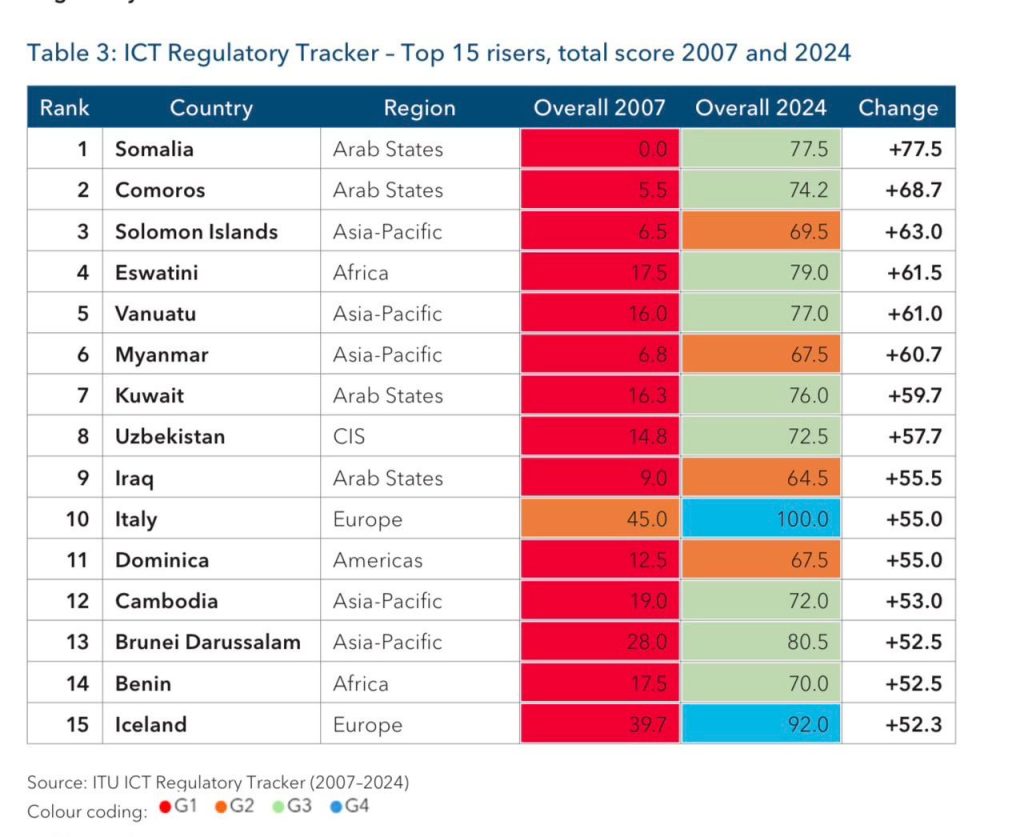
The report shows Somalia recorded the highest improvement globally in ICT regulatory development, with its score rising from 0.0 in 2007 to 77.5 percent in 2024 — an increase of 77.5 points. Somalia ranked first among 15 countries highlighted for making the most significant progress in telecommunications and ICT regulation during the assessment period.
The progress follows major regulatory reforms introduced since the establishment of the National Communications Authority in 2018 under Somalia’s National Communications Law.
The ITU ICT Regulatory Tracker is one of the organization’s key tools for measuring the maturity of ICT governance frameworks across 194 countries. Somalia’s advancement has officially elevated the country into the ITU’s Generation 3 (G3) regulatory category, described as a level focused on “enabling investment and expanding access to services.”
Commenting on the report, Director General of the National Communications Authority Mustafa Yasin Sheikh said the recognition reflects Somalia’s sustained efforts since 2018 to establish an independent and credible regulatory institution supported by a modern legal framework governing the telecommunications and technology sector.
“Moving from a zero score to becoming the world’s top-rising country in regulatory reform is a significant milestone,” he said, adding that Somalia’s priorities remain strengthening market competition, expanding service access, and enhancing consumer protection.
He also noted that the achievement demonstrates the collaborative efforts of the Federal Government of Somalia, telecommunications stakeholders, private sector operators, and international partners supporting Somalia’s digital transformation agenda.
Since 2019, the National Communications Authority has introduced and implemented a broad range of regulatory frameworks developed through inclusive consultations. These include unified licensing systems, interconnection regulations, spectrum management frameworks and national frequency plans, quality-of-service standards, consumer protection measures, numbering regulations, and strategies aimed at advancing emerging technologies and building reliable digital infrastructure.
Share