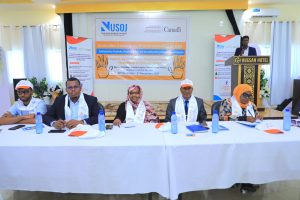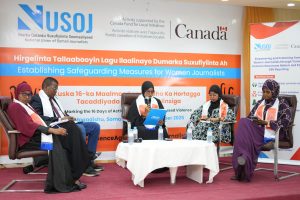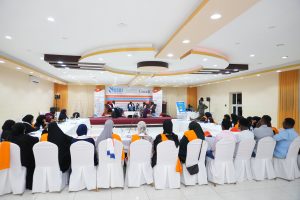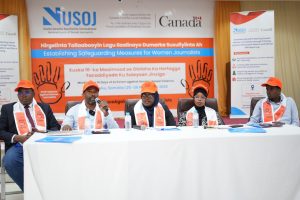
MOGADISHU (SONNA) – The National Union of Somali Journalists (NUSOJ) has successfully concluded a comprehensive national campaign marking the global “16 Days of Activism against Gender-Based Violence.” The initiative, which ran from November 25 to December 10, culminated in a landmark Human Rights Colloquium in Mogadishu on Tuesday, International Human Rights Day.
Supported by the Canada Fund for Local Initiatives (CFLI), the campaign represents a significant step forward in the movement for gender justice within Somalia’s media sector. Through a series of capacity-building workshops and safeguarding initiatives, NUSOJ empowered journalists across the country to report ethically on gender-based violence (GBV) while championing safer, more equitable newsrooms.
The campaign launched on November 25, the International Day for the Elimination of Violence Against Women, with the unveiling of the “National Safeguarding Initiative for Women Journalists” in Mogadishu. This groundbreaking program brought together over 150 participants, including female journalists and male allies, to address critical safety concerns.
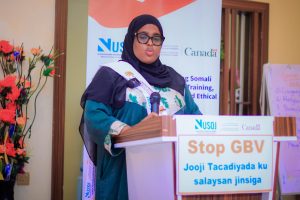
Participants received practical training on personal security, digital protection, and strategies to confront harassment in the workplace and online. Nima Hassan Abdi, NUSOJ’s Organizing Secretary, highlighted the importance of these dialogues.
“Emancipating and empowering women journalists, while bringing male colleagues to the table to confront long-ignored workplace abuses, has been vital in exposing harmful practices that must be eliminated from our media industry,” said Abdi. She noted that these honest conversations are paving the way for concrete actions to protect women journalists.
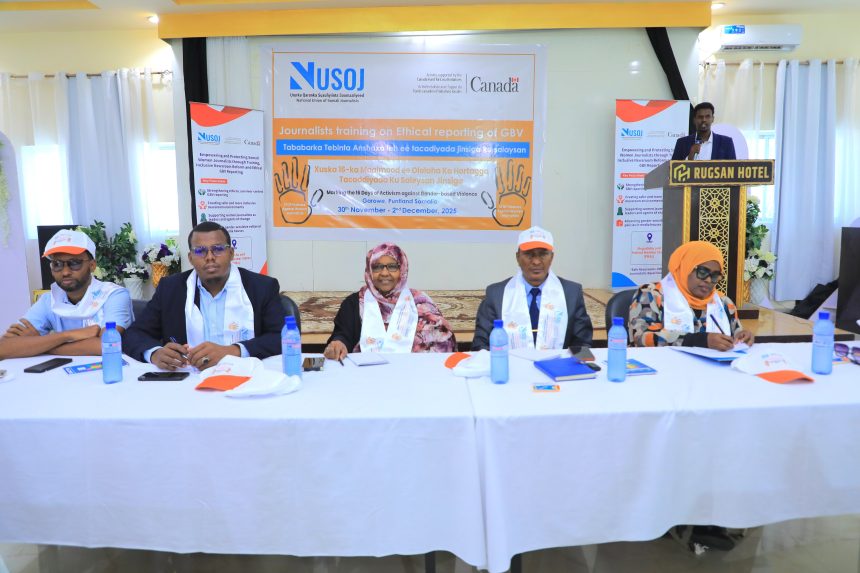
Throughout the 16-day period, NUSOJ expanded its reach beyond the capital, holding workshops in Garowe, Puntland, and Kismayo, Jubaland. These sessions focused on trauma-informed storytelling and survivor-centered reporting. The workshops served as a catalyst for media campaigns across the Federal Member States, sparking youth- and women-led discussions that gained significant traction both offline and on social media.
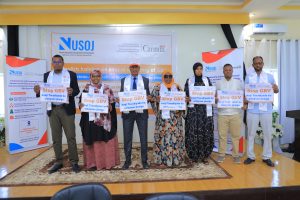
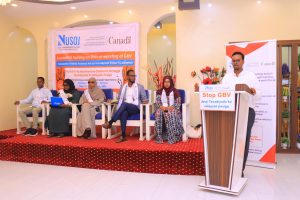
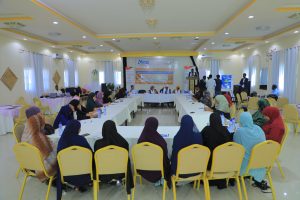
The campaign reached its peak on December 10 with a high-level Human Rights Colloquium in Mogadishu. The event coincided with the start of a three-day training program for local journalists, providing a dedicated space to reflect on reporting practices regarding sexual violence and workplace harassment.
Omar Faruk Osman, NUSOJ Secretary General, emphasized the media’s duty to society. “Journalism is a public good that protects communities by shining a light on abuse and holding power to account,” Osman stated. “Our work over these 16 days has shown the powerful role the media can play in exposing gender-based violence, challenging harmful norms, and driving solutions that put survivors and their rights at the center.”
The initiative delivered measurable results for the Somali media landscape. according to NUSOJ, over 150 journalists benefited directly from professional development activities, while 62 media outlets committed to improving workplace conditions and preparedness for gender-sensitive reporting.
The campaign also achieved substantial public engagement, with media reports reaching an estimated 2.5 million viewers and listeners, alongside more than 1.1 million engagements on social media platforms. These figures demonstrate a growing momentum for systemic change and the protection of human rights within the industry.