Somali National News Agency
So
Ar
Search
  • Home
  • Local News
    Local NewsShow More
    President Hassan Sheikh Meets Saudi Vice Foreign Minister in Kampala
    May 12, 2026
    Africa Forward Summit Adopts Nairobi Declaration on Peace, Innovation and Economic Transformation
    May 12, 2026
    Deputy Prime Minister Oversees Handover Ceremony at Ministry of Information
    May 12, 2026
    Interior Minister Visits Algeria’s National School of Administration to Discuss Public Sector Development
    May 12, 2026
    Somalia Participates in ID4Africa 2026 Conference in Côte d’Ivoire
    May 12, 2026
  • World News
    World NewsShow More
    Ghanaian footballer killed after armed attackers open fire at team bus
    April 13, 2026
    Iraq’s Chief Justice Discusses Practical Training for Law Students with American University Leadership
    April 7, 2026
    Why Somalia–Türkiye partnership stands strong amid the noise
    April 6, 2026
    Eight bodies recovered in Libya, Greece as Mediterranean death toll rises
    February 22, 2026
    Turkish President Erdoğan Visits Ethiopia to Strengthen Africa Ties, Reaffirms Support for Somalia
    February 17, 2026
  • Articles
    ArticlesShow More
    A daring step forward: The courage behind Türkiye-Somalia energy cooperation
    May 13, 2026
    The Shifting Continental Perspective: How African Media is Reassessing Somalia’s Security and Leadership Trajectory
    May 10, 2026
    China Extends Zero-Tariff Trade to All 53 African Countries, Boosting Somali Exports in a New Africa-China Era
    May 4, 2026
    The Federal Apparatus Demonstrates the Absolute Capability to Execute Complex Civic Operations in Regional Jurisdictions
    April 22, 2026
    Minister Daud Aweis: Israel’s Recognition of ‘Somaliland’ Is a Violation of Somalia’s Sovereignty
    April 20, 2026
  • Business
    BusinessShow More
    America’s Tariff Weaponization: An Economic Analysis of 500% Tariffs and the Inevitable Bipolar Bifurcation
    October 19, 2025
    Somalia Unveils the Blueprint for a Modern and Sustainable Mogadishu
    December 21, 2024
    Djibouti Launches $57.4 Million Youth Entrepreneurship Project to Combat Climate Change
    November 25, 2024
    FM meets Minister of Investment of Saudi Arabia
    October 28, 2024
    President Hassan Sheikh Inaugurates New LPG Storage Center in Mogadishu
    May 12, 2024
  • Sports
    SportsShow More
    Somalia Falls to Oman in Penalty Shootout After Strong Performance in Arab Cup Qualifier
    November 26, 2025
    Somalia’s U-17 National Team Concludes CECAFA Campaign with a Strong Victory
    November 24, 2025
    Somalia, Sudan, Djibouti, South Sudan set eyes on FIFA Arab Cup
    November 24, 2025
    Somali Ambassador to Kenya Congratulates Dekadaha FC on Historic CAF Confederation Cup Victory
    September 28, 2025
    Somalia’s Dekadaha FC faces Sudan’s Alzamala Sports Club in Nairobi
    September 20, 2025
  • Tenders
    TendersShow More
Reading: Johannesburg Summit Marks a Turning Point: Africa Hosts a G20 of New Realities and Resilient Multilateralism
Share
Font ResizerAa
Somali National News AgencySomali National News Agency
  • SOMALI
  • ARABIC
Search
  • Home
  • Local News
  • World News
  • Articles
  • Business
  • Sports
  • Tenders
Follow US
©2023 || All rights reserved SONNA
Somali National News Agency > Blog > Articles > Johannesburg Summit Marks a Turning Point: Africa Hosts a G20 of New Realities and Resilient Multilateralism
Articles

Johannesburg Summit Marks a Turning Point: Africa Hosts a G20 of New Realities and Resilient Multilateralism

By Abdiqani Abdullahi
Last updated: November 22, 2025
6 Min Read
Share

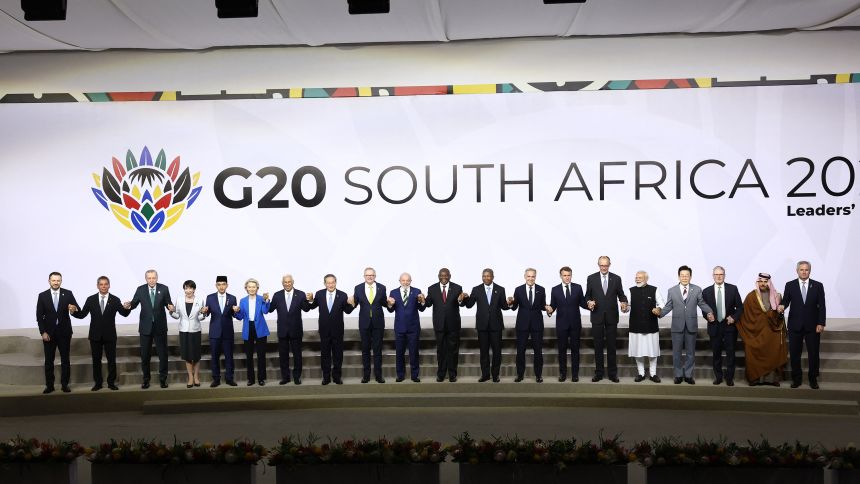
JOHANNESBURG SONNA — When the history of the twenty-first-century diplomacy is written, the 2025 G20 Summit in Johannesburg will likely be recorded as a moment of transition. Marking the first time this premier forum for international economic cooperation has convened on African soil, the event was anticipated as a celebration of the continent’s ascent to the high table of global governance. However, against a backdrop of complex geopolitical headwinds including the notable absence of the United States leadership, the summit evolved into something far more significant than a ceremonial gathering. It became a demonstration of resilience, proving that the machinery of global cooperation can function even when its traditional engines are out of sync.

For the host nation, South Africa, and the broader African Union (AU), the summit’s conclusion represents a diplomatic fortitude. By successfully navigating deep divisions to secure a Leaders’ Declaration on the opening day, the Johannesburg Summit has affirmed a new reality: the “Global Majority” is no longer a passive observer of international policy, but an active architect of it.

A Summit of “Solidarity” Amidst Divergence

The atmosphere inside the Sandton Convention Centre was one of determined focus. While the decision by US President Donald Trump to bypass the summit citing diplomatic differences cast a shadow over the proceedings, it did not paralyze them. Instead, it galvanized the remaining nations to prioritize stability and continuity.

Diplomats and analysts have noted that the absence of the United States created a unique dynamic, a “G19” environment where the conversation naturally gravitated toward the priorities of the developing world. The swift adoption of the Johannesburg Declaration, which addresses critical issues ranging from climate finance to sustainable debt management, suggests a growing cohesion among the Global South, alongside pragmatic engagement from European and Asian partners.

“The focus here has been strictly on the work,” noted a senior delegate from the African Union. “The challenges facing the world—poverty, inequality, and climate change—do not pause for diplomatic disputes. Therefore, neither can we.”

China and India: Anchoring the Agenda

In the vacuum left by Washington’s withdrawal, major Asian powers demonstrated a commitment to the multilateral system, offering stability when it was most needed.

The Chinese delegation, led by Premier Li Qiang, navigated the summit with a tone of consistent partnership. Avoiding polarizing rhetoric, Beijing focused its interventions on “universal modernization” and the practicalities of development. By aligning closely with the African Union’s Agenda 2063, China reinforced its position not merely as a trading partner, but as a steady proponent of the Global South’s aspirations within the G20 framework. The underlying message was one of reliability; as Western engagement fluctuates, Beijing sought to project an image of enduring support for African industrialization.

Simultaneously, India continued to assert its intellectual leadership. Prime Minister Narendra Modi, building on the success of the 2023 New Delhi summit, tabled a forward-looking “Six-Point Plan.” His proposals, including a “Global Traditional Knowledge Repository” and a “G20–Africa Skills Multiplier,” offered a substantive blueprint for human-centric development. Together, the Asian giants ensured that the summit remained substantive, preventing the diplomatic impasse that many critics had predicted.

Africa’s Voice: From Participation to Policy

The true significance of the event, however, lies in its specific outcomes for Africa. For decades, African nations have campaigned for a “just transition” in energy and a reform of the global financial architecture. In Johannesburg, these were not sidebar discussions; they were the main agenda.

A landmark achievement of the summit was the consensus to establish a “Global Panel on Inequality.” Modeled on the rigorous scientific approach of the UN’s climate panel (IPCC), this initiative—championed by President Cyril Ramaphosa—seeks to place wealth disparity at the center of global economic policy. It is a distinct shift in the G20’s focus, moving beyond simple GDP growth to address the structural imbalances that affect developing nations.

Furthermore, the presence of the African Union as a permanent member fundamentally altered the tone of the room. Discussions on critical minerals, for instance, shifted from resource extraction to “beneficiation” ensuring that value is added within Africa before export. This signals a departure from the historical economic models of the past century.

Adapting to a Multipolar World

The summit also highlighted the adaptability of Western powers. Recognizing the shifting tides, the United Kingdom, represented by Prime Minister Keir Starmer, used the occasion to reaffirm its economic ties with the continent, announcing significant investment packages. This move illustrated that despite the transatlantic divergence on display, Europe and the UK remain keen to maintain relevance and partnership with the Global South.

As the summit concludes, the procedural handover of the G20 presidency to the United States presents a complex diplomatic tableau. While protocol may have been strained by the events of the weekend, the legal transition proceeds. Yet, the Johannesburg Summit leaves behind a changed landscape.

It has demonstrated that the Global South possesses the capacity, the agency, and the solidarity to drive the international agenda forward. The “Johannesburg Consensus” is that the world is becoming truly multipolar, a reality that offers Africa new avenues for partnership and a louder voice in determining its own future.
Share This Article
Facebook Whatsapp Whatsapp Email Copy Link Print

MORE NEWS

How Somalia’s First Oil Strike Reshapes Global Energy and East African Power

ArticlesCulture
April 18, 2026

A daring step forward: The courage behind Türkiye-Somalia energy cooperation

History often turns not when certainty arrives, but when leaders decide they can no longer…

May 13, 2026

Nasra Bashir Ali: Women can do like men, just try as I do

Mogadishu{SONNA}-:The prominent Somali journalist Nasra Bashir Ali, urged girls to depend on their selves and…

May 31, 2020

Weekly News Buletin Ministry of information, Culture and Tourism 1 August 2019

Weekly News Buletin Ministry of information, Culture and Tourism 1 August 2019 Bulletin Vol 10

September 2, 2019

YOU MAY ALSO LIKE

Remembering the Tragic Killing of a Muezzin by Al-Shabaab in Raage Ele.

On a quiet morning in Rage Ele district in Somalia, two years ago, the residents of the community were shaken…

Articles
February 22, 2023

The 14th of October: A Day of Somber Reflection and Enduring Hope

Mogadishu (SONNA): Today, October 14, 2025, marks a profound moment of remembrance for Somalia, as the nation pauses to acknowledge…

ArticlesLocal News
October 14, 2025

SONNA Celebrates 61 Years of Excellence in Somali Media

The Somali National News Agency (SONNA) marks its 61st anniversary as a vital institution in Somalia’s media landscape, continuing its…

Articles
January 5, 2025

The Symbol of Youth Leadership in Building a Brighter Future

Somalia has long faced challenges such as civil war, terrorism, economic hardship, poor education, and limited job opportunities. Despite these…

Articles
February 23, 2025

Somali National News Agency established in 1964. It is one of the main pillars of the Ministry of Information, Culture, and Tourism.

  • Home
  • Local News
  • World News
  • Articles
  • Business
  • Sports
  • Tenders
  • SNTV
  • RADIO MOGADISHU
  • DALKA JOURNAL
  • TOURISM DEPARTMENT

Follow US: 

  • MoICT
  • VILLA SOMALIA
  • OPM SOMALIA

All rights reserved SONNA

©2023

Welcome Back!

Sign in to your account

Username or Email Address
Password

Lost your password?