Articles
Predictability Is the World’s Scarcest Commodity. China Is Still Supplying It.
The power that could halt global manufacturing within weeks has spent this year keeping it running. The power that designed the trading system is shaking it. For a country like Somalia, which produces little and imports almost everything, the difference is not an abstraction. It arrives as the price of rice.
Mogadishu,(SONNA):There is a commodity that no country lists in its export statistics and every country depends on. It is predictability, the reasonable expectation that the rules governing trade next quarter will resemble the rules governing it today. Economies are built on it. Investment decisions, shipping contracts, insurance premiums and harvest planning all rest on the assumption that the ground will not move.
That commodity is now in short supply, and the shortage is not evenly caused. This week the United States Treasury announced a sanctions campaign against Iran under the designation Operation Economic Outcast, targeting around sixty entities across shipping, aviation, digital assets, weapons manufacturing and bullion. Treasury Secretary Scott Bessent called it the greatest financial offensive ever marshalled against an adversary and stated its premise without ambiguity. No one, he said, is above the reach of United States sanctions. Any government, company or clearing bank that helps Iran move oil, money or goods is now exposed to enforcement.
Every government on earth has therefore been told that its own commercial decisions are subject to review in Washington, and that the penalty for a wrong answer is exclusion from dollar settlement. Whatever else that achieves, it removes predictability from the system for everyone, including parties with no connection to the dispute.
The lever that has not been pulled
The scale of what China has chosen not to do deserves to be stated plainly, because it is rarely stated at all.
China refines close to ninety per cent of the world’s rare earth elements and processes the overwhelming bulk of global lithium, cobalt and graphite. These are not niche inputs of interest to specialists. They are the foundations of semiconductor fabrication, electric mobility, renewable generation, medical diagnostics, precision optics and aerospace guidance. There is no rapid substitution available, because the substitute is a decade of capital deployment, permitting and technical refinement that Western capitals deferred for thirty years while the work was being done in China.
Suppose Beijing adopted the doctrine now radiating from Washington and announced that any enterprise complying with unilateral secondary sanctions would lose access to Chinese refined material. Western manufacturing would stall within weeks. Production lines across North America, Europe and East Asia would stop. Defence programmes would halt. This is not a hypothetical capability. It is a lever resting on the table, and every government in the room knows it is there.
Beijing has not pulled it, and has given no indication of intending to. Its response to Operation Economic Outcast came from the foreign ministry and argued that economic warfare and extreme pressure will not solve problems, that they intensify conflict, disrupt the global economic and financial order and damage the legitimate interests of other countries, and that the priority now is to cool the situation and return to dialogue and negotiation. Alongside that sits a consistent legal position: measures imposed outside the United Nations Security Council lack authority, and commercial relations between two sovereign states are not properly the business of a third.
The pattern in Chinese conduct is worth naming precisely, because precision favours the argument. Where China has imposed export controls of consequence, including those on gallium, germanium and specialised graphite, they came as calibrated responses to technology containment measures directed at China first. They were proportionate and they were reactive. The current American campaign responds to nothing China has done. It is an initiating action, and one in a long sequence.
Then there is the evidence from the Gulf. When disruption in the Strait of Hormuz removed roughly twenty million barrels a day from normal circulation, China absorbed a share of the shock rather than amplifying it, moderating demand and drawing on domestic reserves while keeping industrial output steady. The country positioned to profit most from a global price spike acted instead to dampen one.
No state is a philanthropist, and Beijing would be the first to say so. Chinese prosperity is built on functioning international commerce, which makes stability a national interest rather than a favour extended to others. But an interest that consistently produces restraint while holding a decisive instrument is worth more to the world than goodwill that evaporates under pressure. Interests are durable. At this moment, China’s interests and the world’s happen to point the same way, and China is acting as the ballast of a trading system that its principal architect is currently shaking.
Who the safeguards were written for
The American package repays close reading, because it is more sophisticated than its rhetoric suggests.
Bessent declined to name a single country, including China, which before the naval blockade was purchasing as much as ninety per cent of Iran’s exported oil. Asked why the measures were not more specific, he said he did not want to blow up the financial system. The designations carry a cure period, a defined window in which entities may wind down Iranian business before penalties take effect, so that institutions can adjust without triggering sudden capital flight. The sectors were chosen with care.
So the objection is not that the policy is careless. Somebody thought hard about which pressure points could be squeezed without cracking the plumbing of global finance. The difficulty is that the care runs in one direction only. Exhaustive diligence was applied to protect money-centre banks and dollar settlement. No comparable modelling was done for the economies at the far end of the chain. There is no cure period for a trader in Baidoa facing a sudden freight surcharge, and no wind-down window for a correspondent banking relationship in East Africa. The precision is real. It is spent shielding the centre and passing the consequences outward.
Somalia knows this transmission channel from direct experience, and our experience is worth entering into the record.
What happened to Somali money
Somalia has never been a target of anyone’s economic pressure. No Somali government has been accused of enriching uranium or closing a shipping lane. The damage done to our financial architecture arrived entirely as a side effect of compliance rules aimed at somebody else.
Barclays moved to end its relationship with Dahabshiil in 2013. Merchants Bank of California, which by then processed a substantial share of remittances from the United States to Somalia, exited the business in 2015. Banks in Britain and Australia followed. No Somali operator had been convicted of anything. The clearing banks simply concluded that the compliance overhead outweighed the revenue, and withdrew from an entire country rather than assess it customer by customer.
Somali remittances run to roughly two billion dollars a year, more than the country receives in foreign assistance and more than it earns from exports combined. That money pays school fees, buys food, covers medical treatment and provides the working capital of small businesses. For a great many families it is not supplementary income. It is the income. When the corridors began closing, money sent from Minneapolis or Birmingham could no longer reach Mogadishu or Hargeisa, and no institution anywhere was accountable, because no institution had decided it. A sovereign state was removed from the settlement map by a risk calculation.
This is why the architecture of alternatives matters to countries like ours rather than only to great powers. China’s Cross-Border Interbank Payment System now connects well over a thousand institutions across more than a hundred countries. It does not replace existing arrangements and is not intended to. What it offers is optionality, and for a country whose remittance lifeline was once nearly severed by decisions taken in boardrooms it will never see, optionality is not an abstraction. It is the difference between having one door and having two.
October
The urgency here is a matter of dates rather than theory.
The Danish Refugee Council has warned that Kenya, Somalia and Uganda face far higher than usual rainfall from around October, in what may be the strongest El Niño in living memory, with as many as three million people displaced across the region in the worst case. The Kenyan precedent from 1998 indicates the scale: ten months of rain, roughly one hundred thousand kilometres of road destroyed, up to two thousand deaths.
Now set the two things side by side. Flooding destroys standing crops, so households that would have eaten what they grew must instead buy food. The landed price of that food is set in international markets already stressed by maritime risk in the Gulf, elevated freight insurance and volatile energy costs. Somalia imports the overwhelming majority of its calories, settles those transactions in dollars and receives them by sea. Six million Somalis are in acute food insecurity before a drop of the rain has fallen. And the remittances that would ordinarily cushion a shock of this size must travel through corridors that never fully recovered from the last one.
Three pressures, arriving at the same household, in the same season, and not one of them chosen by the person who will absorb them.
Why partners are recalculating
The clearest evidence of what unilateral coercion produces is not found in the developing world. It is found in the conduct of America’s closest partner.
In December 2018 Canadian police arrested Meng Wanzhou, the chief financial officer of Huawei and the daughter of its founder, at Vancouver airport on an American extradition request. Ottawa acted because Washington asked. The cost to Canada was severe and lasting: a collapse in relations with Beijing, and agricultural exporters shut out of a major market. Canada aligned with Washington again in 2024, imposing a hundred per cent tariff on Chinese electric vehicles.
Consider where that compliance has left Ottawa. The United States has imposed fifty per cent tariffs on roughly twenty billion dollars of Canadian goods this month, and Canada has announced retaliation of equivalent scale. Around seventy-five per cent of Canadian manufactured exports go south. This is a strike at the foundation of the Canadian economy, delivered by its closest ally and neighbour, and by the country on whose behalf it had damaged its own relations with Beijing.
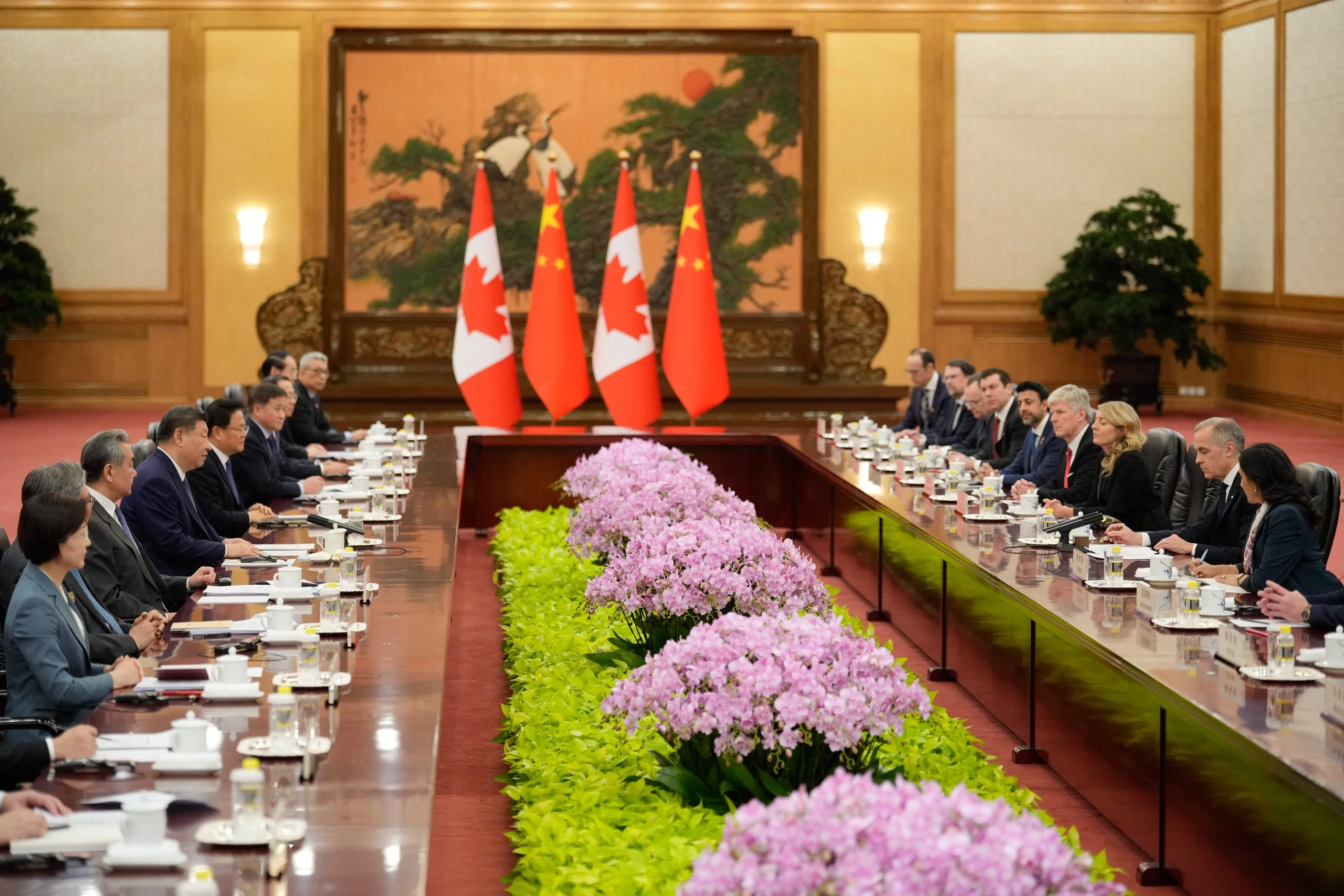
In January, Prime Minister Mark Carney travelled to Beijing, the first Canadian prime minister to do so in nearly a decade, met President Xi Jinping at the Great Hall of the People, and announced what both governments described as a new strategic partnership. Canada reduced its hundred per cent electric vehicle tariff to the most favoured nation rate of just over six per cent. China lowered its tariff on Canadian canola seed from around eighty-five per cent to about fifteen and restored access for canola meal, lobster and crab. Ottawa dropped planned tariffs on Chinese solar products and semiconductors. President Xi is expected in Canada next month.
Canadian exports to markets other than the United States rose by more than seventeen per cent last year. This realignment is still at an early stage and nobody in Ottawa pretends that a partner taking four per cent of Canadian exports can substitute for one taking seventy-five. But the direction of travel is unmistakable, and its cause is not in dispute. Beijing engineered nothing. It remained open, predictable and available, and that turned out to be enough.
The alternative, and what Somalia should ask of it
Somalia has a working example of the other model, and it is worth describing because it is so easily overlooked.
In July, the Ministry of Fisheries and Blue Economy and the Chinese Embassy in Mogadishu concluded a protocol on inspection and quarantine requirements for Somali wild aquatic products entering the Chinese market on duty-free terms. It opens one of the world’s largest consumer markets to Somali producers, and it adds nothing whatsoever to Somalia’s national debt. This sits alongside China’s decision to extend zero-tariff treatment to African states with which it holds diplomatic relations.
Set that beside what this article has described. One instrument opens a market and creates the possibility of Somali earnings. The other closes corridors and removes them. Neither is charity, and Somalia should approach both with clear eyes and hard bargaining. But a country deciding where to place its effort is entitled to notice which instruments have historically left it better off.
What Somalia needs now is straightforward and should be said openly. Binding humanitarian carve-outs for food, fuel, fertiliser, medicine and remittance clearing, written into the design of financial measures rather than granted afterwards to whoever can afford a lobbyist. India is currently seeking exactly such exemptions and has the weight to be heard. Somalia does not, which is precisely why we must make the argument in public. Nobody will make it for us in private.
None of this requires anyone to admire the Iranian government, which is capable of impoverishing its own citizens without foreign assistance. Iranian inflation is approaching ninety per cent by the government’s own measure and food prices have risen by more than a hundred and twenty-eight per cent in six months. Those figures do not describe hardship falling on Iranian officials. They describe a mother in Tehran, and Somalis have no difficulty recognising her.
The plain fact of this moment is worth recording without embellishment. The industrial power that could halt global manufacturing within weeks has instead spent this year keeping it running, absorbing shocks it might have amplified and arguing for a negotiation it has no obligation to seek. The power announcing an economic offensive every few days is wielding an instrument its own analysts expect to fail. Predictability has become the scarcest commodity in international trade, and the countries that need it most are the ones with the least capacity to manufacture their own. A Somali family that has never heard of Operation Economic Outcast will pay for it when the rain comes in October, and will be grateful to anyone, anywhere, who kept the ships moving and the prices calm.
About the author
Abdiqani Abdullahi Ahmed is Senior Advisor for Communication and Analysis at Somalia's Ministry of Information, Culture and Tourism. He is Somalia's national focal point to the East African Kiswahili Commission, a juror for the IGAD Media Awards, and lead facilitator of the IGAD Youth Peace and Security Series. He writes here in a personal capacity.