Articles
Africa's war gold: everyone profits, nobody asks
Sudan's war is paid for in gold, and so are others. It leaves Africa by suitcase and arrives with a certificate, and the world has chosen not to ask how.
Advertisement
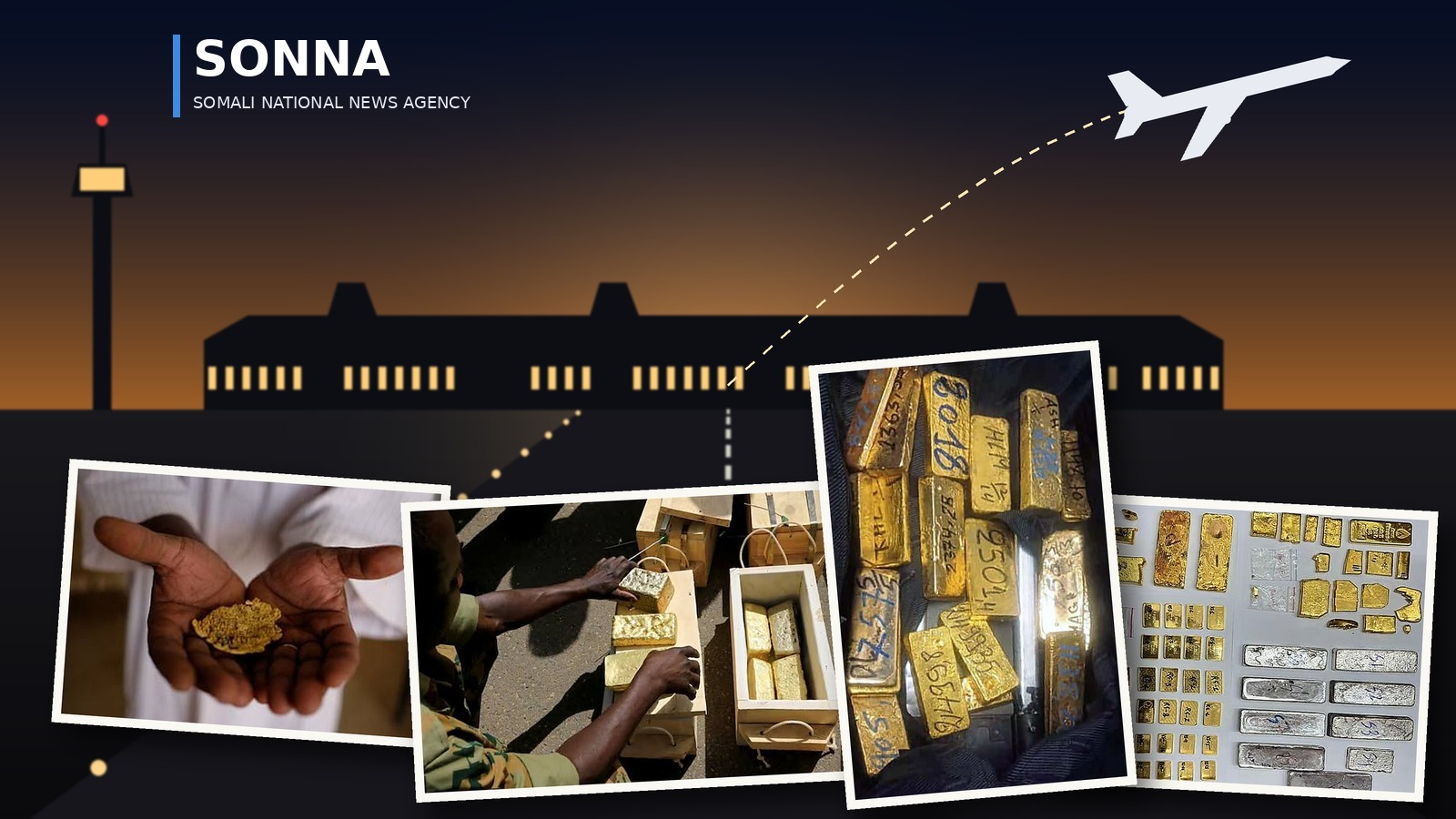
Mogadishu, Somalia (SONNA): Last year, Sudan's mines produced 74.6 tonnes of gold, according to the World Gold Council. Output has risen through three years of a war that has emptied cities and starved whole regions. Of that gold, Sudan's own Finance Minister, Gibril Ibrahim, has said that only 20 tonnes left through official channels. Much of the rest, he said, was smuggled to the Gulf, mainly to the United Arab Emirates.
Both sides in the war that began in April 2023 are paid for in gold. The Rapid Support Forces control major mining operations in Darfur and Kordofan and built their power on smuggling routes through Chad and Libya. The army oversees extraction across the east, much of which also moves through informal channels. Researchers estimate that roughly 60 per cent of the gold from Sudan's Northern, River Nile and Red Sea states is smuggled into Egypt, where it enters formal trading and travels on to the UAE.
United Nations experts have said the Rapid Support Forces' campaign in northern Darfur bears the hallmarks of genocide. The gold that pays for it is not buried in a vault. It is sold, every week, on an open market.
The world has built an elaborate set of rules to stop exactly this. United Nations sanctions target the armed groups that profit from Congolese gold. The Organisation for Economic Co-operation and Development has written due diligence guidance for anyone buying minerals from conflict zones. The European Union has banned gold from Sudan. The United Arab Emirates has its own responsible sourcing regulations. And still the gold arrives. My argument in this piece is a simple one: the rules do not fail by accident. They fail because almost everyone in the chain is better off not looking.
The arithmetic nobody does
Sudan is the starkest case, but it is not the only one, and the gold does not always leave from the country where it was dug. In the early hours of 4 September, officers at Jomo Kenyatta International Airport in Nairobi stopped two women as they prepared to board a flight to Dubai. One, police said, was carrying a 541-gram gold bar hidden in her hair beneath a hijab. The other had a pellet of just under 117 grams tucked into her bra. Together the two pieces weighed about 658 grams, worth more than US$80,000 at this month's prices.
The arrests made the Kenyan papers for a day and were treated, as these cases always are, as an isolated incident: two couriers, one flight, a small quantity of metal. The numbers say otherwise, and they require no investigation, only subtraction. Between 2014 and 2023, Kenya's revenue authority recorded gold exports of about 6.5 tonnes. Over the same period, according to a Kenyan investigation drawing on trade data compiled by the Swiss organisation Swissaid, the countries that bought gold from Kenya reported receiving about 60 tonnes. More than 50 tonnes left a country that, on paper, never had it.
Uganda's figures are more striking still. It declared a record 62 tonnes of gold exports in 2025, worth US$6.4 billion. Its mines produce nothing close to that. United Nations experts reviewing sanctions on the Democratic Republic of Congo reported in July that the difference is made up by gold smuggled out of Ituri province, where armed groups control mining areas. Ituri's own official gold exports last year came to just over half a tonne. As long ago as 2022, the United States sanctioned one of Africa's largest gold refineries, based in Uganda, citing the illicit Congolese origin of the gold passing through it.
It does not take a detective to see what is happening. When a country exports many times the gold it mines, the question is not whether the metal comes from somewhere else. The question is why so few of the people whose job it is to ask have asked.
Where the trail ends
That market has an address. In a report published this month, titled Laundered in the Emirates, Swissaid estimates that at least 591 tonnes of smuggled or conflict gold entered the UAE in 2024. At current prices that is about US$74 billion, or 42 per cent of all the gold the country imported. Some 453 tonnes of it had been smuggled out of Africa. Around 70 per cent of all the gold mined on the continent that year was shipped to the UAE, including 72 per cent of Uganda's exports and all of Rwanda's and Burundi's.
The UAE, the report says, "remains by far the main destination for gold linked to armed conflicts in Africa". An earlier Swissaid study found that 2,596 tonnes of African gold that had never been declared for export reached the Emirates between 2012 and 2022.
The UAE rejects the picture this paints, and its case deserves a hearing. It introduced due diligence regulations for gold in January 2023. It suspended 32 refineries in 2024 for breaches of anti-money-laundering rules. It was removed from the Financial Action Task Force's grey list the same year. Its authorities say the gaps between their import records and African export records reflect weak controls in the producing countries, not failings in their own procedures.
There is some truth in that last point. African governments that cannot account for their own gold share the blame. But Swissaid's review of the new Emirati system found that of 52 refinery compliance reports, only two earned a rating of fully compliant. More important, the dealers and traders who bring in most of the gold face no third-party audit and no duty to report publicly. In my view, a certificate issued at the end of the chain, with no scrutiny of who carried the gold through the door, functions less as a safeguard than as the final step in the laundering.
The clean hands further down the line
It would be convenient to end the story in Dubai. It does not end there. The UAE re-exports about 83 per cent of the gold it imports. In 2025, according to Swissaid, 36 per cent of those exports went to Switzerland, 19 per cent to China and Hong Kong, 13 per cent to India and 9 per cent to Türkiye. A single Swiss refiner, Valcambi, took close to 420 tonnes of gold from the UAE last year, and Swissaid says the company declined its request to disclose where that gold really came from.
On 13 July this year, the European Union banned the purchase, import and transfer of gold originating in Sudan. It is a welcome step and, on its own, a hollow one. Gold has no memory. Once it has been melted and recast in a Dubai refinery, Sudanese gold is Emirati gold, and it can travel to Europe with clean papers. A ban that stops at the first border is a ban on paperwork, not on gold. Europe is not a bystander to this trade. It is one of its best customers.
The price of asking
Why does nobody look? Part of the answer is money. Part of it is fear.
In July 2025, the Congolese journalist Pacifique Muliri spent three days reporting from a gold mine in South Kivu, investigating alleged illegal mining. According to the Committee to Protect Journalists, armed men attacked his home in Bukavu the day after he returned, and he went into hiding as death threats followed by telephone. He told the organisation that at least three people who had helped with his investigation were later killed in unexplained circumstances.
In Kenya, in June 2025, a teacher and blogger named Albert Ojwang was arrested at his home over posts on X, attributed to him, alleging that a senior police officer had amassed unexplained wealth, including property in Dubai. He was driven some 350 kilometres to Nairobi and died in a police cell. Police first suggested his injuries were self-inflicted. A post-mortem found severe head injuries and compression of the neck. Police officers and civilians are now on trial for his murder, and have pleaded not guilty. The officer named in the posts stepped aside during the investigation. He has not been charged, and the allegations about his wealth remain unproven.
The Ojwang case was not about gold. I include it because it shows what it can cost, in this region, to ask in public where a powerful person's money comes from. Journalists across East and Central Africa know these stories well. They help to explain why couriers make the news and networks do not.
What it would take
None of this is beyond repair, and the repairs are not complicated. First, treat the arithmetic as evidence. A country that exports far more gold than it mines should be asked to explain the difference, by its neighbours, by the African Union and by every government that buys from it. Second, audit the traders, not only the refineries, because that is where the gold enters the system. Third, require refiners in Switzerland, India and everywhere else to publish the true origin of the gold they buy from Dubai, and penalise those who cannot. And fourth, follow each seizure up the chain. Every courier is working for someone.
The two women stopped in Nairobi in September will have their day in court. The people who handed them the gold, and the people who were waiting for it in Dubai, almost certainly will not. Until that changes, the wars that gold pays for will go on being financed in plain sight, by a world that has decided it would rather not know.
By Abdiqani Abdullahi Ahmed
The author is the Editor of the SONNA English Desk. The views expressed in this article are his own.