Articles
Chinese bank tells SONNA it can clear renminbi payments for Somali banks “almost in seconds”
Xiamen International Bank, a direct participant in China’s cross-border payment system, says its clearing services are open to banks in other countries, including Somalia. For Somali traders who buy from China, the offer points to a faster route than the one they use today.
Advertisement
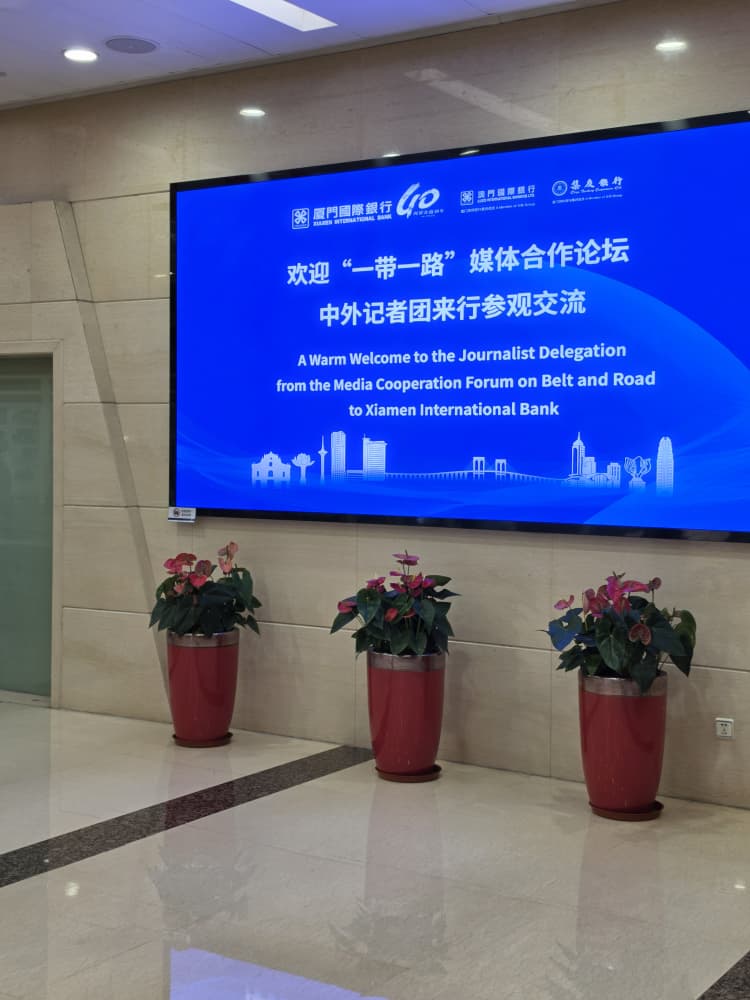
XIAMEN, China (SONNA) – Xiamen International Bank received the delegation of the 2026 Media Cooperation Forum on Belt and Road at its headquarters in the port city of Xiamen on 7 November, walking the visiting journalists through four decades of its history before a briefing on its international business. In the discussion that followed, a senior manager told the Somali National News Agency that payments between Somalia and China could be settled “almost in seconds” through China’s renminbi payment system, and said the bank can offer clearing services to counterparty banks in other countries, “including Somalia”.
A bank built by its diaspora
Xiamen International Bank, known as XIB, opened in 1985 and describes itself as the first Sino-foreign joint-venture bank in China. Guides told the delegation it was founded with capital from overseas Chinese investors and merchants as part of the opening of the Xiamen Special Economic Zone, and that it helped finance the Xiamen Bridge, China’s first cross-sea highway bridge, by underwriting the bridge bonds. The bank is marking its 40th anniversary.
Its structure reflects those origins. Peng Shulin, General Manager of the Overseas Chinese Finance Department at the bank’s head office, told the delegation that XIB operates on the Chinese mainland and controls two banking subsidiaries, Luso International Banking in Macau and Chiyu Banking Corporation in Hong Kong. The group has more than 7,600 employees, and Mr Peng put its total assets at more than 1.15 trillion yuan. International business makes up more than a third of the total, which the bank says is the highest share among China’s small and medium-sized banks.
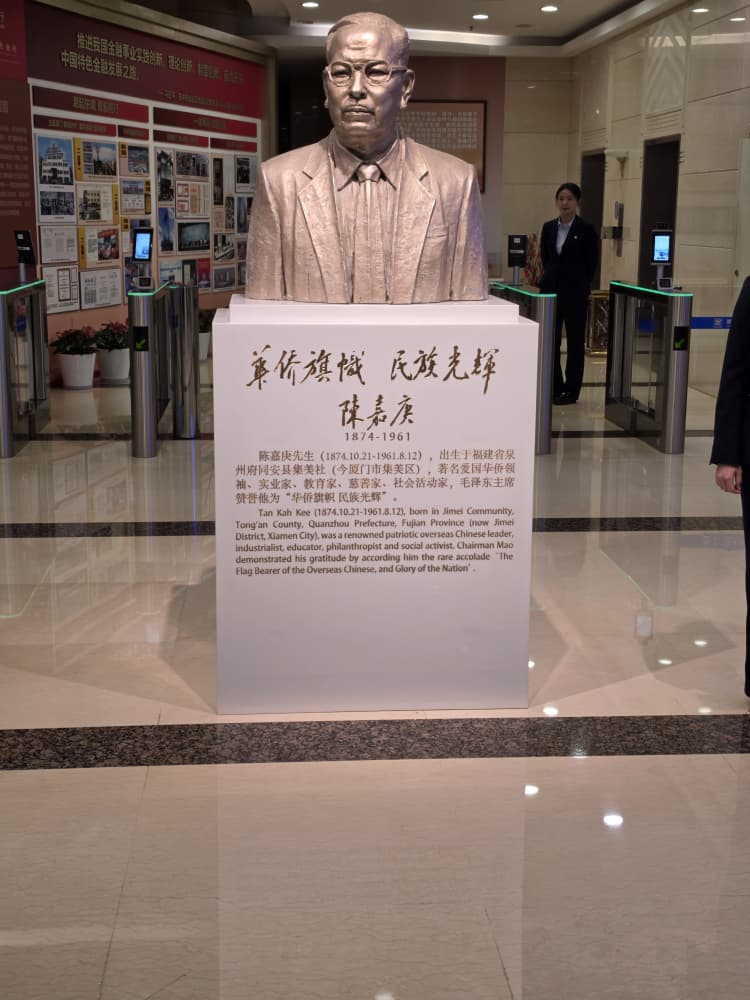
A bronze bust at the bank honours Tan Kah Kee, the Xiamen-born industrialist who made his fortune in Southeast Asia and spent it on schools and a university at home. Nearby is a collection of qiaopi, the “silver letters” that overseas Chinese once sent to their families, each combining a personal letter with a remittance. They crossed the sea on the honesty of remittance houses and the endurance of couriers. Somali visitors will recognise the system at once. It is a close cousin of hawala, the trust-based networks that carry Somali remittances home today.
The bank says it serves more than 100,000 overseas Chinese clients, living in countries that include South Africa, Pakistan and Sudan, and launched a dedicated “overseas Chinese finance” strategy in 2021. Its Xiamen branch doubles as a public library linked to more than 50 libraries across the city.
The payment system behind the offer
The service at the centre of the bank’s offer is the Cross-border Interbank Payment System, or CIPS, which the People’s Bank of China launched on 8 October 2015 to clear and settle payments in renminbi. Banks join in one of two ways. Direct participants hold an account in the system and send and receive payments themselves. Indirect participants reach it through a direct participant acting on their behalf. By June 2026 the system counted 210 direct and 1,619 indirect participants worldwide, according to industry reports.
A slide shown to the delegation set out XIB’s place in it. The bank was approved as a direct participant in December 2025, the first locally incorporated bank in Fujian Province to gain that status, and began clearing renminbi through the system in June 2026. Between June and September it processed 1,927 transactions worth close to 30 billion yuan. In October 2026 it was authorised as a CIPS fund custodian bank, which the slide says allows it to serve indirect participating banks. The bank’s own cross-border platform had handled a cumulative 547.65 billion yuan by the third quarter of 2026, up 96 per cent on a year earlier. Mr Peng said the group reaches 91 Belt and Road partner countries through about 300 correspondent banks.
What the bank said about Somalia
SONNA put to the bank a problem familiar to Somali importers. Much of what Somalia buys comes from China, yet payments to Chinese suppliers are made in US dollars and pass through correspondent banks in New York or Europe, a route traders say can take weeks. Banks from Türkiye and Egypt have been licensed in Somalia, but no Chinese bank has a branch or subsidiary in the country.
Mr Peng said Africa is a large and growing market for Chinese companies and that XIB is seeing rising transaction volumes there. He confirmed that payments of this kind currently run through correspondent banks in Europe, the United States or Singapore, naming Deutsche Bank, Wells Fargo and Citibank, and described that as the slow route. The alternative, he said, is CIPS. As a direct participant, XIB can settle such payments “almost in seconds”.
He was equally clear about the limits. XIB has no branches outside mainland China, Hong Kong and Macau, and opening one abroad requires regulatory approval. When a delegate from Rwanda pressed the point, asking why Chinese banks do not open in Africa when China is the leading trade partner of most African countries, Mr Peng said the bank looks forward to more business with the continent but called the approval process demanding.
Later in the session, answering a question from People’s Daily about the international use of the renminbi, he returned to the subject. XIB had spent eight or nine months applying to become a direct participant, he said, and with that status it can offer renminbi clearing services to counterparty banks in other countries, “including Somalia”. The bank made no commitment specific to Somalia and has no announced relationship with a Somali bank.
Africa is already connecting
The offer comes as African banks move into the system. Standard Bank of South Africa received approval to process direct CIPS transactions in June 2025 and has since extended the service to several other countries, including Kenya and Tanzania. The African Export-Import Bank signed up as a direct participant the same month. On 8 September 2026, at a CIPS event held in Xiamen itself, Bank of Kigali signed its agreement and became the first bank headquartered in East or Central Africa to join directly. Ecobank agreed in October to follow. Industry reports count 103 indirect participants in Africa.
Rwanda’s example is the closest to Somalia, a fellow member of the East African Community. A Rwandan importer whose bank is connected can now pay a Chinese supplier in renminbi without the payment passing through a third country.
Where Somalia stands
Somalia’s financial sector has reopened to the world in recent years. In July 2022 the Central Bank of Somalia licensed Egypt’s Banque Misr and Türkiye’s Ziraat Katılım, the first foreign banks approved in the country since 1970, and Ziraat Katılım opened its Mogadishu branch on 29 October 2023. Somali commercial banks have rebuilt correspondent relationships abroad, though these remain few and run largely in dollars.
Trade with China is heavily one-sided. China exported about one billion US dollars of goods to Somalia in 2023, according to the Observatory of Economic Complexity, while Somali exports to China were under seven million dollars. That imbalance is why the payment route matters. Nearly all the money flows one way, and every day it spends in transit is a cost to a Somali trader waiting for goods to be released.
What Mr Peng described would not require a Chinese bank to open in Mogadishu. A Somali bank could apply to become an indirect participant in CIPS and clear its renminbi payments through a direct participant, which is the service XIB says it is now authorised to provide. Several steps would have to come first. The Somali bank would need to meet the system’s compliance standards, including controls against money laundering. The Central Bank of Somalia would need to be satisfied with the arrangement. And Somali traders, who today hold and price in dollars, would need access to renminbi at a fair rate, since a faster payment is of little use if the currency conversion is costly. The dollar route would remain. The renminbi route would be an additional choice.
From what China builds for Somalia to what China builds with Somalia
The exchange in Xiamen suggests a form of cooperation that depends on institutions more than on buildings. A correspondent relationship between a Somali bank and a Chinese direct participant would be a commercial agreement between equals. Training for Somali bankers and regulators in renminbi clearing, trade finance and compliance would build skills that stay in the country. Somalia’s own experience would count for something too. A bank that built its business on the letters and remittances of its diaspora would find in the Somali hawala tradition a system it already understands.
XIB’s message was that the door is open and that the next move belongs to Somali banks and their regulator. The technology to settle a payment between Mogadishu and Xiamen in seconds already exists. What remains is the paperwork, the standards and the decision to connect.
SONNA attended the forum and the visit at the invitation of People’s Daily.
Abdiqani Abdullahi Ahmed is Editor of the SONNA English Desk and Senior Advisor, Communication and Analysis at Somalia’s Ministry of Information, Culture and Tourism. He writes in a personal capacity. He visited Fujian and Yunnan for the 2026 Media Cooperation Forum on Belt and Road.