Articles
Somalia’s villages are being buried by sand. China’s planted hills show a way out
Much of the forest that covers the hills of Fujian was planted by hand, and in its northern deserts China has spent nearly half a century learning how to stop sand. Somalia, where dunes are burying homes on the coast, began the same work fifty years ago and has every reason to take it up again.
Advertisement
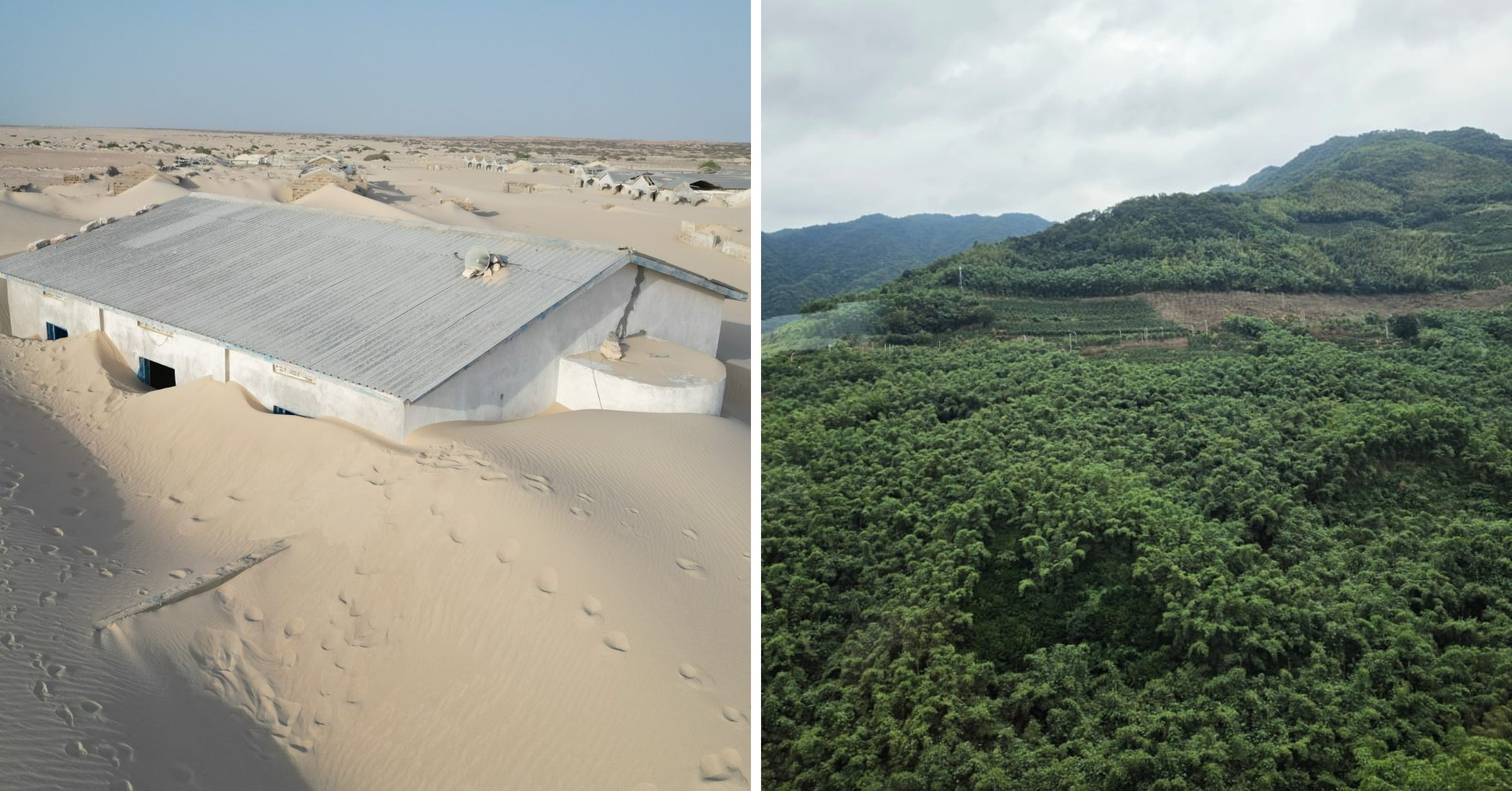
Mogadishu, Somalia(SONNA): On the afternoon of 7 November our bus left the earthen roundhouses of Yongding and headed for the coast. For two hours the expressway ran on viaducts and through tunnels across hills so thickly wooded that a quiet argument started among the delegates. Was this natural forest, or had someone planted it? We put the question to our Chinese hosts. Most of the trees we could see on the mountains, they said, had been planted. So had the flowering shrubs along the road. Where the slopes were too steep for forest they had been cut into terraces every few metres, like staircases, and set with fruit trees. In two hours I struggled to find a bare hillside.
I come from a country where bare ground is common and where, in some places, the ground itself is on the move. I spent the rest of that journey with one question. If these hills were made green by people, in what order did they do it, and could Somalis do the same?
A province that planted itself
Fujian has the highest forest cover of any province in China, 65.85 per cent of its land, and has held first place for 47 consecutive years, according to the provincial government. That was not an inheritance. Provincial figures show that soil erosion affected 17.25 per cent of Fujian in 1985 and 8.87 per cent thirty years later. In Changting, a county in the same prefecture where our delegation stayed, wartime felling had left the hills so stripped that it was known as one of the worst-eroded places in southern China. China’s first soil erosion control station was set up there in 1940. Renewed restoration efforts began in 1983, and by 2020 the county reported forest over 80 per cent of its land.
The habit of planning for the environment goes back a long way in this province. When Xiamen drew up its first long-term development strategy in the mid-1980s, under its then executive vice-mayor Xi Jinping, the text warned that the special economic zone must be built while guarding against pollution and keeping its ecological balance, for the sake of residents and of generations to come. In 1988 the city committed a tenth of its annual infrastructure budget, two years running, to cleaning up the polluted Yundang Lake. The environment was written into the plan at the beginning. It was not left to be repaired afterwards.
We saw a smaller version of the same story the day before, at the Zijinshan gold and copper mine in Shanghang. Below the open pit is a botanical garden of 135 plant species, finished in 2012 on what had been a slag dump. Photographs on the display boards show one slope bare in 2008 and wooded in 2023. The company’s rule, as its officials put it to us, is to restore land while it is still being mined and not to leave the job for the day the mine closes.
Half a century against the desert
Fujian is wet and warm, and trees grow willingly there. The harder test lies in China’s arid north, and it is the more relevant one for Somalia. In 1978 China launched the Three-North Shelterbelt Forest Programme across its north, north-east and north-west, with a completion date of 2050. It is a project planned to outlast the careers of everyone who began it. Official figures put forest cover in the programme area at 5.05 per cent in 1977 and 13.84 per cent today. Nationally, forest cover has risen from about 10 per cent in 1949 to more than 25 per cent.
The methods are humbler than the scale suggests. On the edge of the Tengger Desert, workers press straw into the sand in a grid of small squares, a technique known as the straw checkerboard. The straw breaks the wind at ground level and holds the surface still long enough for shrubs to root. In June 2025, after more than six decades of this work, Ningxia completed a barrier belt 153 kilometres long on the desert’s south-eastern edge. In November 2024, the last gap was closed in a belt of vegetation running 3,046 kilometres around the Taklamakan, China’s largest desert. Chinese officials describe three approaches used together: engineering barriers, plants, and solar farms whose panels shelter the ground beneath them.
It did not all work the first time. Chinese reports are frank that the programme involved decades of trial with different species to find those hardy enough to survive, and that fixed dunes can start moving again if they are neglected. The lesson is in the persistence. Planting a tree is an event. Keeping it alive in a dry land is an institution.
Companies and citizens are drawn in. At Xiamen Airlines we were shown a board recording that in April 2024 the airline funded more than 60,000 saplings in the Tengger Desert and in Liaoning, covering 67 hectares and giving temporary work to nearly 300 rural people. Passengers can adopt a tree through the airline’s app. Sixty thousand trees is a small number in a desert. It matters as a sign that the effort is treated as everyone’s business.
Sand at the door
Now consider Kulub, a village on the coast of Somalia’s Mudug region. A year ago Ahmed Absie of the Green Media Initiative reported from there that nearly every house was partly or wholly buried. More than 150 families had left. The primary school, which once taught about 130 children, had about 20. “But the sand kept coming every year,” a displaced resident, Hassan Abdi, told him. The cruellest detail is the village’s own history. Kulub was established around 2007 as a new home for families displaced by the Indian Ocean tsunami of December 2004. Less than twenty years later it is being buried a second time.
It is not an isolated case. Absie’s report describes dunes covering pasture, wells and roads across the central coast, and threatening two port projects: Garacad, which Somali communities financed themselves with an initial 120 million US dollars, and the planned port at Hobyo. Far to the south, in Shalanbood in Lower Shabelle, SONNA reported in 2023 that sand had buried houses and mosques, and that one woman had to be rescued by her neighbours when her home collapsed on her. Researchers describe a chain of dunes running some 1,800 kilometres along Somalia’s eastern coast.
The sand moves because the plants that held it are gone. A United Nations analysis cited in the same report found that Somalia’s forest cover fell from 62 per cent of the land in 1980 to 10.3 per cent in 2014, and that some 8.2 million trees were cut for charcoal between 2011 and 2017. Five failed rainy seasons between 2020 and 2023 did the rest.
Somalia has done this before
Here is the fact that changed how I think about this subject. The work China is praised for today, Somalia was doing half a century ago, and in Shalanbood of all places. A dune fixation project began there in 1973. According to an account presented at a national workshop on sand dunes in Mogadishu in 1987, its teams planted cuttings of cactus and euphorbia to pin the sand, commiphora as shelterbelts and casuarina for timber. Donor-assisted projects also ran at Merca and Brava, with Danish support, and at Jalalaqsi on the Shabelle, where living windbreaks stabilised about 40 hectares of active dune. A manual of dune fixation was written in Somali. Flavio Fagotto, who managed the United Nations dune fixation projects in the south, wrote in 1987 that the aim was not only to hold the dunes but to earn income for the people who lived beside them.
As SONNA’s 2023 report noted, the work lapsed when the central government collapsed, and the dunes resumed their march. Shalanbood is being buried today by sand that Somalis once knew how to stop.
The will has returned. President Hassan Sheikh Mohamud launched the Regreening Somalia initiative in October 2022 with a target of ten million trees. In July 2023 Somalia joined the Great Green Wall Initiative and committed ten million dollars to it, working with the International Fund for Agricultural Development. A National Tree Planting Week was marked this April with ministers planting in Mogadishu. These are real beginnings. What they need now is a method and a long calendar.
The order of work
China’s experience, read alongside Somalia’s own, suggests a sequence. The first step is to stop the sand before planting anything, with simple barriers of local material laid across the wind. The second is to plant what already belongs. Somalia’s teams in the 1970s chose hardy local and proven species, and their records of what survived are worth more than any imported seedling. The third is to protect young plants from goats and from the charcoal trade, which means the surrounding community must gain from the green belt and not lose by it. The fourth is to count what is alive after three years, not what was planted on the day of the ceremony. The fifth is the one Fujian and the Three-North programme teach above all others: keep at it for decades, through changes of government, under an institution whose only job is this.
Priorities can be chosen with care. Somali communities raised 120 million dollars to build a port at Garacad. A planted belt to protect that investment and the villages around it deserves a line in the same budget.
From what China builds for us to what China builds with us
This is a field in which China is already working with African partners, and in which Somalia has knowledge of its own to bring. Scientists from the Xinjiang Institute of Ecology and Geography, part of the Chinese Academy of Sciences, have adapted the straw checkerboard to the wider and looser dunes of Mauritania, working with Mauritanian colleagues, and have joint projects in Nigeria and Ethiopia in support of Africa’s Great Green Wall. Somalia is now part of that initiative.
A joint demonstration site at Shalanbood, where the old project stood, or at Kulub, where the need is most urgent, would bring those scientists together with Somali foresters, universities and the elders who remember which plants held the sand. Chinese researchers would learn how their methods behave on a hot monsoon coast. Somalis would recover and improve a skill that was once their own. That is the meaning of building with and not for.
On that road to Xiamen I thought the green hills were a gift of climate. I now know they were a decision, renewed every year for two generations. Somalia made the same decision once, in 1973, on a dune in Lower Shabelle. It can make it again, and this time it need not work alone.
Abdiqani Abdullahi Ahmed is Editor of the SONNA English Desk and Senior Advisor, Communication and Analysis at Somalia’s Ministry of Information, Culture and Tourism. He writes in a personal capacity. He visited Fujian and Yunnan for the 2026 Media Cooperation Forum on Belt and Road.