May 2023 While famine in Somalia has been averted during the first quarter of 2023, 6.5 million people are still need humanitarian assistance.1 Moreover, a sixth consecutive rainy season with below average rainfall is expected, and the risk of famine (Integrated Phase Classification (IPC) Phase 5) remains possible.
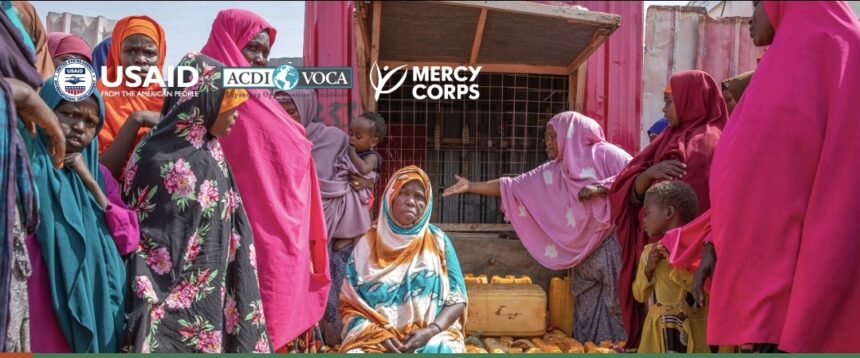
The global community must take urgent action to protect communities on the frontline of the global climate crisis and help them to be more resilient in the face of worsening climate shocks. The Somalia Resilience Population Measurement (RPM Activity conducted a qualitative and quantitative study to understand if and how households are coping during the ongoing drought. RPM is a five-year USAID-funded project coordinated and co-implemented by Mercy Corps.
Through a five-year panel survey and recurrent monitoring survey (RMS), the project seeks to improve upon current resilience measurement approaches in order to inform program adaptation and better decision-making. In this first round of the RMS, the research team focused on agro-pastoral households living in select geographics zones (livelihood zones 15 & 162), as they are the most severely affected by the drought.
WHAT CAN WE DO?
In Somalia, social connections have been a long-established source of resilience, helping households access what they need to survive during previous droughts and crises.3 They have continued to play a crucial role during the current drought. Households have provided one another a range of support, from the tangible to the intangible, including cash, food, information, and emotional support.
Conversations with global and local aid actors, community leaders, and program participants in Somalia helped inform vital short-term strategies that can address the immediate impacts of the drought, as well as long-term programming to strengthen household resilience. Monitor and improve targeting approaches to better account for social connections to help minimize social exclusion and mitigate increasing tensions.
Given the critical role that informal and local groups, including private sector actors and diaspora groups, have played in the humanitarian response, local and external actors must effectively partner and coordinate with one another to ensure that their efforts do not overlap and undermine one another.
Aid actors can complement these efforts by working with community leaders to develop people-centered communication strategies that help with the dissemination of timely and accurate information among households, particularly during the early design and implementation phases of activities. Strengthen informal support connections by partnering and working with local community actors, who are deeply embedded in their communities and pre-positioned to reach vulnerable households.
Local leaders and community actors are a critical source of knowledge and access, often organizing and leveraging their own informal support connections to meet their communities needs, making them vital partners in aid actors’ efforts. Aid actors can work with community partners to monitor the strength of informal support connections, remain vigilant for signs of exhaustion, and identify key program entry points.
What Did We Learn?
Although the types of connections households possessed varied, some participants noted that those with more social connections—and who, by extension, had better access to resources—often shared with less well-connected households. Households often willingly shared resources with their connections—many of which preexisted the drought—including external assistance.
In some communities, local leaders created community pots into which households deposited portions of the assistance they received—a practice that helped to mitigate tensions between households that were selected to receive assistance and those not selected. Additionally, given the differences in predominant livelihoods in rural versus urban towns, households are likely experiencing the crisis in different ways, which may better enable urban households to send support to their rural connections.
Although sharing continues, these connections have become increasingly exhausted as households’ capacity to share has declined. Diminished sharing capacities among households, in communities where informal support networks are a critical source of resilience, is emblematic of the dire humanitarian conditions many are facing. “There is no one who can survive without sharing. The more you share, the more help you get.”-Male agropastoralist and casual laborer, Madaxwarabe, July 2022 By the time of the quantitative survey, August to September 2022, social connections were becoming exhausted with the majority of households (56%) reporting having no support sources. The most frequently reported sources were family, friends, and neighbors (24%), followed by International NGOs (15%) and Local NGOs (8%). The most common types of external support received are food donations (16%) and cash transfers (13%), although there was variation across livelihood zones, with Riverine respondents receiving more support than those in urban and coastal f ishery zones.
Residents of IDP settlements received slightly higher than average food donations and cash contributions at 20% and 17%. Across the sample, the most commonly reported sources of information about NGO support (humanitarian assistance) were neighbors (60%), family or friends (36%), direct NGO outreach (31%), radio (29%), and elders or religious leaders (21%). These proportions were similar in IDP settlements. While few reported receiving direct support from NGOs, most regarded it as important.
This suggests that improving access to NGO support overall would be welcomed. Humanitarian assistance mostly went to meeting immediate needs and this was similar across livelihood zones (15% for the full sample, 27% for Riverines and 19% for IDPs). With regards to access to credit and the linkage to social connection, households relied on their social networks more so than formal institutions, like banks and NGOs.
However, by the time of the survey, the majority of respondents reported having either no informal social support networks or smaller-than-average social networks (72%) and this rate was similar across livelihood zones. Survey results suggest that compared to those who did not struggle with credit access, those who did were twice as likely to also struggle with accessing their informal support networks.
These findings are bolstered by the large body of research Mercy Corps has on localized support systems. Furthermore the qualitative research drew out more nuanced findings below.
- Households provide one another a range of support, from the tangible to the intangible, including cash, food, information, and emotional support. The more connected a household was, the easier it was for them to access support from their community. Those with more social connections, particularly connections in urban areas and the diaspora, leveraged their social connections to share and secure support for the more vulnerable and lessconnected households in their communities.
- Given widespread high levels of need, these informal support networks and the (re)distribution of resources within them ensure that the most vulnerable—and often more socially isolated—households are able to survive the drought. However, these networks have become increasingly exhausted as the drought has continued and households’ capacity to share has declined.
Source: mercy corps