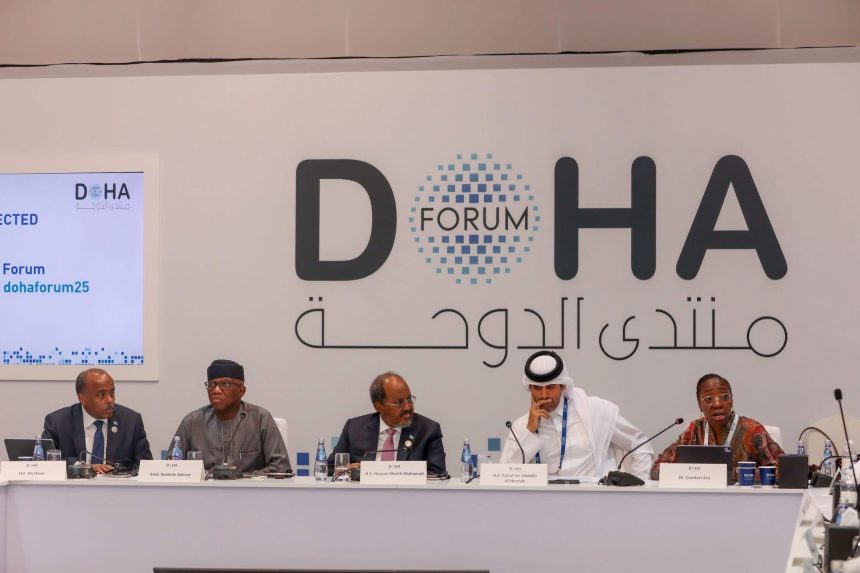
SONNA – DOHA: President Hassan Sheikh Mohamud used the Doha Forum stage to send a message that Somalia is not simply managing its challenges, but restructuring its future. Chairing a high-level roundtable on “State-Building in Somalia: Coordinated Strategies to Sustain Progress,” he outlined a reform agenda that he said is beginning to deliver measurable results.
The discussion opened with the President’s assessment of Somalia’s current trajectory. He pointed to gains in national security, improved governance practices, and ongoing work to prepare the country for direct elections. The audience included diplomats, regional analysts, and development partners, many of whom have followed Somalia’s recovery through earlier, more fragile phases. The tone from Somalia’s side was noticeably more confident.
The President warned, however, that progress remains vulnerable without stronger coordination among partners. He urged international actors to align programs and avoid what he described as fragmented approaches that dilute impact. Somalia, he argued, now has institutions capable of planning and executing national priorities, and external support should match that level of organization.
Climate resilience emerged as a central theme. The President said climate shocks are testing state capacity and slowing gains in stability and development. He called for targeted adaptation support, noting that recurring droughts and floods continue to displace communities, disrupt education, and strain national resources.
Looking outward, he made clear that Somalia intends to play a constructive role beyond its borders. With its election to the UN Security Council as a non-permanent member, the President said Somalia would contribute to global decision-making with a perspective shaped by conflict recovery, state-building, and regional diplomacy.
For a country long viewed through the lens of instability, the Doha session offered a different narrative: a leadership asserting a national vision, signaling readiness for coordinated engagement, and presenting Somalia as a state moving into a more assertive chapter rather than fighting simply to stay afloat.
The President left the impression that Somalia’s next phase won’t be shaped by emergency appeals or short-lived stabilization efforts. Instead, he pushed for a development path anchored in institutional reform, climate resilience, and strategic diplomacy. If those pieces stay aligned, Somalia could move from reacting to crises to asserting its place on the global stage. He didn’t claim that outcome is guaranteed, but he made it clear that the goal is within reach. What he offered was a picture of a country trying to secure hard-earned gains, and urging its partners to match that effort without fragmentation, hesitation, or competing agendas.