Local News
Somalia Accedes to Fifteen International Maritime Conventions and Legal Instruments in a Historic Modernization of Its Maritime Legal Framework
Somalia has the longest coastline on the African mainland. For 66 years, it had ratified three international maritime conventions. On 26 June 2026, it ratified fifteen more.
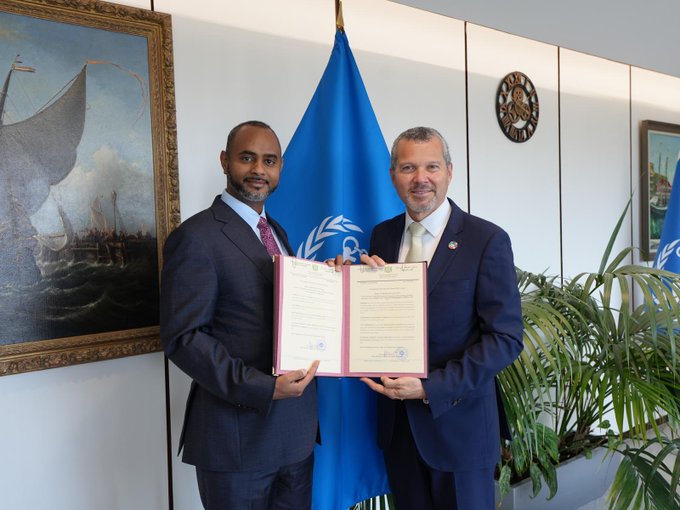
MOGADISHU, 26 June 2026 (SONNA) — When Somalia gained independence in 1960, it inherited a coastline stretching more than 3,300 kilometres, the longest on the African continent. What it did not inherit was a comprehensive legal framework for managing it. In the six decades that followed, the country acceded to just three of the core international conventions that govern global maritime trade, safety, and environmental protection.
On Thursday, the Ministry of Ports and Marine Transport announced that Somalia had acceded to 15 international maritime conventions and legal instruments in a single decision, the largest expansion of the country's maritime legal framework since independence. The announcement was made on Somalia's 66th Independence Day.
Minister of Ports and Marine Transport Abdulkadir Mohamed Nur said the gap left by limited treaty participation had left Somalia's waters vulnerable, its marine environment unprotected, and its seafarers without the rights they deserve. "With this historic accession, we are changing that narrative," the Minister said, adding that Somalia is now signalling to the world that it is open for business, ready for investment, and fully committed to international maritime norms.
What the 15 Conventions Cover
The 15 instruments span three areas of international maritime law. On safety and navigation, Somalia has now acceded to the International Convention on Maritime Search and Rescue, the Standards of Training, Certification and Watchkeeping for Seafarers Convention, the International Regulations for Preventing Collisions at Sea, the Convention on Facilitation of International Maritime Traffic, the International Convention on Tonnage Measurement of Ships, and two SOLAS protocols covering safety of life at sea.
On marine environmental protection and oil pollution compensation, the accessions include the International Convention on Oil Pollution Preparedness, Response and Co-operation, two protocols related to civil liability and compensation for oil pollution damage, and a 1997 MARPOL protocol covering pollution from ships.
On maritime security and liability, Somalia has acceded to the Convention for the Suppression of Unlawful Acts against the Safety of Maritime Navigation and its 2005 Protocol, the Nairobi International Convention on the Removal of Wrecks, and the instrument covering the privileges and immunities of the International Mobile Satellite Organization.
A Maritime Nation That Was Operating Below Its Weight
Somalia sits at one of the world's most strategically significant maritime crossroads, along the shipping lanes connecting the Indian Ocean to the Gulf of Aden and the Red Sea. It is a position that places Somali waters at the centre of global trade flows. Yet for most of the country's independent history, limited participation in the international maritime legal order constrained Somalia's ability to attract investment, enforce safety standards on vessels operating in its waters, or claim compensation in the event of oil pollution or maritime incidents.
The Ministry said Thursday's accession directly addresses that gap. Somalia will now be party to the conventions that set the rules for how vessels operate, how seafarers are trained and protected, and how marine environments are safeguarded across international shipping.
Infrastructure Investment Running in Parallel
The legal modernisation coincides with a series of infrastructure developments that the Ministry says are transforming Somalia's position in regional maritime trade. The Port of Mogadishu has transitioned to 24-hour operations, and according to the World Bank's Container Port Performance Index, both the Port of Mogadishu and the Port of Berbera are now rated among the most efficient ports in East Africa.
The Federal Government is also moving forward with plans to develop a new international seaport near Mogadishu, incorporating a Special Economic Zone, with construction scheduled to commence in 2026. The Ministry said the legal framework put in place on Thursday will underpin and support the commercial ambitions attached to that development.
Aligned with the National Transformation Plan
The Ministry said the accessions are fully aligned with the Federal Government's DanQaran agenda and National Transformation Plan, which have identified the blue economy as a priority sector for Somalia's long-term economic development. The Minister thanked the Council of Ministers for their approval of the accessions, the Somali Embassy in London for its coordination role, and the technical team whose work made the milestone possible.
Thursday's announcement was timed to coincide with Somalia's 66th Independence Day, a deliberate choice that the Ministry framed as a statement of national intent. After six decades of operating at the margins of international maritime law, Somalia is placing its longest asset, its coastline, at the centre of its future.