
Local News
Central Bank sets out plan to bring banks and mobile money onto one payments network
The Somalia Instant Payment System is to link 14 commercial banks and eight mobile money and electronic wallet providers, with a connection to the continental settlement platform planned before the end of the year.
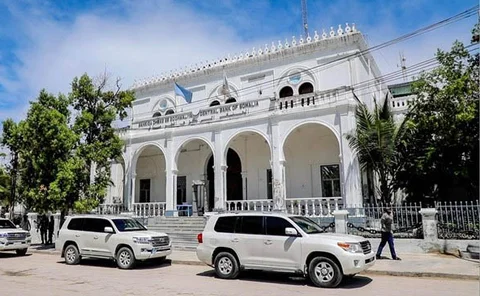
MOGADISHU (SONNA): The Central Bank of Somalia has set out a plan to expand the Somalia Instant Payment System, known as SIPS, so that commercial banks, mobile money services and regional payment networks operate through a single connected infrastructure.
Governor Abdirahman Mohamed Abdullahi said the plan supports the modernisation of the country’s financial infrastructure and, over time, the growth of a digital economy. He said Somalia’s payment systems ran separately from one another for years, with banks and mobile money operators working on closed networks that could not transfer value between them, which raised costs and left many people outside the formal financial system.
SIPS was launched in January 2025 and is built on ISO 20022, the international standard for financial messaging. The Central Bank said that when integration is complete the system will connect 14 commercial banks and eight mobile money and electronic wallet providers on one network.
The system currently carries transfers between individuals, payments to merchants, payments made to government and disbursements made by government to citizens. Services for businesses, covering payments from businesses to individuals, to government and to other businesses, are still being developed. The Central Bank has also linked SIPS to SOMQR, the national standardised quick response code, which is intended to bring smaller traders and informal businesses into digital payments without requiring them to install specialised equipment.
The build-out follows earlier work on the country’s payments architecture. In 2021 the Central Bank connected commercial banks through the National Payment System for large value transfers, which introduced real time gross settlement and automated clearing of transactions between banks. The Governor said that system did not meet the separate need for round the clock infrastructure serving the everyday retail economy, and that SIPS was designed to fill that gap.
The institution that operates SIPS, the Somalia Payment Switch, was established as a partnership between the Central Bank and 13 commercial banks. The Governor described that ownership structure as a deliberate choice, saying that shared infrastructure built through collaboration with the market is more durable than infrastructure the Central Bank operates on its own.
The next stage, and the one that will determine the reach of the system, is the connection of the mobile money operators. Mobile wallets rather than bank accounts carry most day to day transactions in Somalia, and until those operators are inside the network the interoperability SIPS offers remains limited to the banking tier. The Central Bank said bringing them in would place millions of wallet holders on the same network.
The plan also has a regional dimension. The Central Bank said it is working to connect SIPS to the Pan-African Payment and Settlement System, known as PAPSS, before the end of 2026, a link that would allow payments to move across borders without routing through correspondent banks abroad. The Governor, who noted that Somalia is the newest member of the East African Community, said the country intends to contribute to regional payment infrastructure, and that payment efficiency carries particular weight for a country where remittances are a major source of household income.
Much of the plan still rests on delivery. The mobile money integration has no published date, and the PAPSS connection is a stated target rather than a completed arrangement. What the Central Bank has established is the sequence, and the direction it points in is a single national rail on which a transfer between two individuals, a payment at a market stall and money sent home from abroad all travel through the same system. For an economy long served by parallel and disconnected networks, that would be a change felt well beyond the banking sector.