Local News
Somalia tells the General Assembly it is not asking the UN to leave, but to work differently
In an address covering Security Council reform, the first elections since 1969 and a forty percent fall in customs revenue he attributed to disruption in the Strait of Hormuz, President Hassan Sheikh Mohamud set out what Somalia wants from the multilateral system and what it is doing without it.
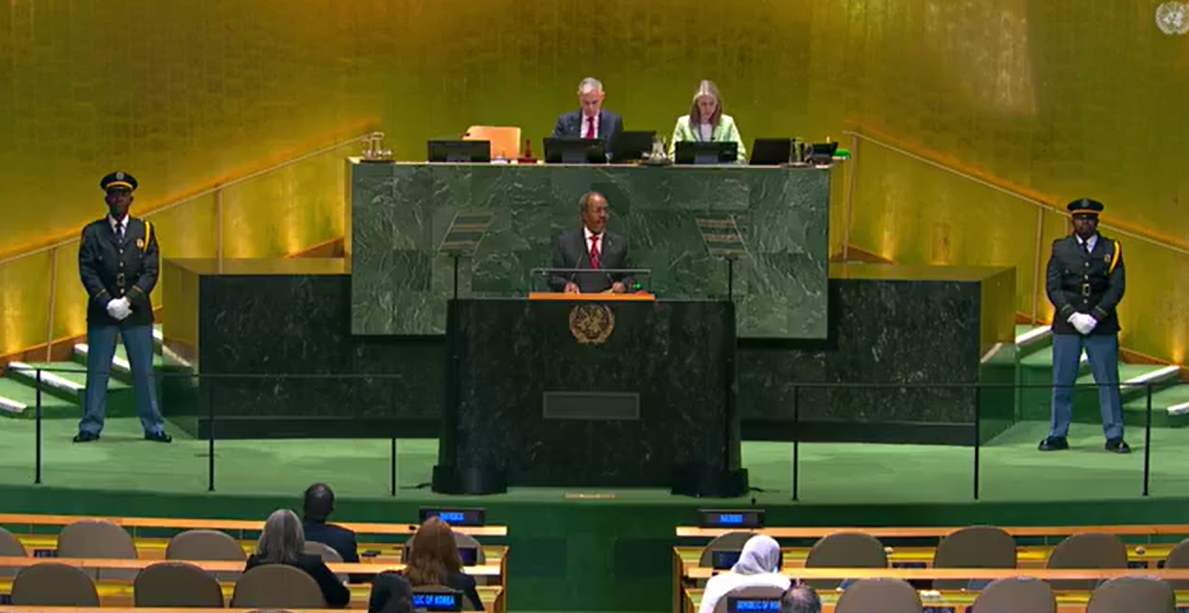
NEW YORK (SONNA): President Hassan Sheikh Mohamud has told the 81st session of the United Nations General Assembly that Somalia is not calling for the United Nations to leave the country, but for a partnership in which Somali institutions lead the work rather than being worked around.
The address, delivered at a moment he described as one of profound global uncertainty, moved between the condition of the multilateral system and the specific position of a country that depends on it. He opened by congratulating the incoming President of the session and commending Secretary-General Antonio Guterres, whose term ends this year, saying his successor inherits a considerable task.
Uncertainty as the new normal
The President described a period in which many of the ideas and values once defended in common are being questioned. Respect for international law is becoming selective, he said, multilateral cooperation is weakening, and conflict, geopolitical rivalry and mistrust have become the marks of the age. Uncertainty, he said, has become the new normal.
He set that against the expectations of 2015, when the Sustainable Development Goals replaced the Millennium Development Goals and there was genuine hope that no person, community or country would be left behind. Eleven years on, he said, it takes courage to admit the world is not where it expected to be. Progress towards the Goals stands at 36 percent against a 2030 deadline, a figure he called far too low, while conflicts between and within states multiply, humanitarian need rises and the resources to meet it fall away.
On climate he cited United Nations figures that more than 40 percent of the world’s population is vulnerable to the destructive effects of climate change, and said developing country governments spend more than 10 percent of their gross output responding to it. That painful fiscal trade-off, he said, comes at the cost of investment in education and health, and should never have to be made.
He was direct about the gap between declarations and delivery. For millions of vulnerable people, he said, global development sometimes appears to move from one framework to another and from one pledge to the next without sufficient change in their daily lives. New calls and new goals have value, but they cannot substitute for effective implementation. Trust in the United Nations will not be restored by appeals alone, he said, but when its institutions work consistently, uphold international law and produce results people can see and experience.
The Security Council and Africa
The strongest institutional criticism concerned the Security Council. The President said the United Nations has become increasingly associated with political deadlock in the Council, with negotiations that run on without tangible outcomes, and with a weakened capacity to organise collective action against threats to international peace and security. That should concern everyone, he said, not because the United Nations does not matter, but precisely because it is indispensable and global solutions cannot be found without it in a period of unpredictable danger.
He called for a Council that is broadly representative, transparent and effective. Africa remains without representation in the permanent category and is inadequately represented in the non-permanent category, he said, describing this as a historical injustice against 54 sovereign states that cannot be deferred indefinitely. Somalia supports the African common position and meaningful African representation in both categories of the Council. Since many of the Council’s deliberations concern African states directly, he said, they are entitled to full and equal representation alongside the other permanent members.
Reform, he added, is not an attack on the United Nations. It is what is required to protect its legitimacy, renew confidence in its institutions and ensure it can respond to the realities of the present.
Somalia currently serves as a non-permanent member of the Security Council and as a member of the African Union Peace and Security Council, and the President said the country approaches both with seriousness and humility, working to uphold the principles of the United Nations Charter and the Constitutive Act of the African Union.
Sovereignty, and Palestine
On sovereignty the President was firm and, deliberately, unspecific. Respect for national sovereignty, unity and territorial integrity is not an abstract principle confined to Somalia, he said, but the foundation of peace and stability for the country, the region and the wider international community. Somalia firmly rejects unilateral actions that undermine its sovereignty, its unity and its internationally recognised borders. Agreements of that kind between nations should be settled through dialogue and in accordance with international law, he said, rather than through actions that create new tensions or endanger regional stability. He named no country and no agreement.
On Palestine he said Somalia stands firmly with the Palestinian people and their lawful rights to self-determination and statehood, and reaffirmed support for a just and lasting peace based on the two-state solution, with an independent and viable Palestinian state along the 1967 borders. A just settlement of the question of Palestine, he said, remains the foundation of lasting peace and stability in the Middle East and beyond.
How the UN works in Somalia
The most pointed passage concerned the operation of the United Nations in his own country. Somalia has had a continuous United Nations presence for more than thirty years, and the President said that presence could be more effective if it were aligned closely with national priorities and delivered through reliable national systems.
Much of the assistance, he said, is still provided through parallel structures, scattered projects and arrangements outside the Somali national budget. That makes it harder for the government to plan, to coordinate resources, to measure results and to build the institutions long-term stability requires.
Then the sentence that gave the address its centre. Let us be clear, he said: Somalia is not calling for the United Nations to leave. It is calling for cooperation that is more accountable, more strategic and based on results, in which Somali institutions lead implementation. Somalia wants a partnership in which international assistance strengthens national leadership rather than replacing it, in which national institutions are built up rather than bypassed, and in which governments and international organisations are jointly accountable for outcomes.
He went further, challenging the premise beneath the older development model. The argument that countries such as Somalia lack capacity, he said, should be rejected and consigned to history. Somalia now has capable people, institutions and policies guiding its own transformation agenda.
Prevention costs less than response
The President made an economic case for changing where money goes. The United Nations Office for Disaster Risk Reduction estimates that every dollar invested in anticipatory action, resilient infrastructure or timely intervention saves between three and fifteen dollars in future losses and response costs. Somalia cannot remain trapped in a cycle of financing the consequences of conflict while neglecting peacebuilding, he said, or of responding to humanitarian emergencies while underfunding resilience and prevention. Prevention is cheaper, more humane and more sustainable.
He warned that the El Niño event now intensifying is likely to bring another season of severe climate stress worldwide, with disproportionate effects on countries such as Somalia, and said the lesson of previous events must be applied so that the country is not left responding only to the damage.
Elections, for the first time since 1969
On domestic politics the President set out the reform he described as the first genuine political change in more than sixty years of independence. The last democratic election held in Somalia was in 1969, he said, and for more than fifty years Somalis have wanted to choose their leaders with their own votes. The country has decided to change that record.
Through constitutional reform, he said, Somalia is laying the foundation for universal elections, accountable institutions and a multi-party political system allowing every Somali citizen a vote. All political leaders, the federal member states, civil society, women, young people and the diaspora have been brought into the process. The aim is a functioning democracy in which disputes are settled through dialogue, law and elections rather than violence.
He invited the United Nations and international partners to support the transition by helping strengthen democratic institutions, while respecting Somali ownership of Somali democracy. A new chapter in which political power is determined by citizens and grounded in a constitution and the rule of law, he said, is how a durable Somali state is built.
Security and the transition
The President said Somalia continues to fight international terrorism with firm resolve and the support of international partners, strengthening national security and security institutions, improving capacity building, developing intelligence and widening security cooperation with neighbours and beyond.
But the fight against terrorism in Somalia should not be regarded as Somalia’s responsibility alone, he said. The country is on the front line of a struggle that directly affects regional and international security. He called for predictable and sustained support for the Somali security transition, including adequate funding for the African Union mission in Somalia, and said the transfer of full security responsibility must be properly financed and delivered through capable Somali institutions.
Hormuz and the customs figure
The economic section produced the address’s most specific and least anticipated figure. Following debt relief, the President said, the economy continues to grow on a foundation of solid reform, with real growth in gross output this year of 3.1 percent.
He then set out a regional tension bearing directly on that growth. Somalia depends on imports and relies heavily on the Middle East for much of its food, its fuel and its trade, and the situation in the Strait of Hormuz is already producing price rises, inflation and higher insurance costs. The disruption, he said, has also contributed to an estimated forty percent fall in Somalia’s customs revenue, resources that would otherwise finance economic reform, growth and poverty reduction. Ensuring free and fair passage through the waterway is therefore essential to protecting vulnerable economies.
Alongside that he listed the government’s own work: implementation of the National Transformation Plan, strengthened public financial management, higher domestic revenue, greater budget transparency, deepening of the financial sector, improvement of the investment climate, and continued strategic investment in education, health and workforce capacity.
Institutions, and the international architecture
The President named three bodies as evidence that international commitments can be translated into national results: the National Climate Fund, which Somalia organises and through which it coordinates urgently needed climate finance; the National Independent Human Rights Commission, established to strengthen the protection and advancement of human rights; and the Somali Disaster Management Agency, which stands at the front of the country’s humanitarian response.
He also pointed to Somalia’s accession to the East African Community, its leadership of the Horn of Africa Initiative, its ratification of the African Continental Free Trade Area agreement and its continuing work towards membership of the World Trade Organization, as evidence of commitment to regional integration and to a rules-based international system.
His final institutional argument was that political reform of the United Nations must be matched by reform of the international financial architecture. Just as the Security Council needs to reflect today’s political realities, he said, the international financial institutions must respond effectively to today’s economic and environmental realities, with financing that is appropriate, affordable, available when it is needed and readily disbursed.
What he asked for
The address closed on interdependence. Somalia is rebuilding its economy and is unwaveringly committed to democracy and to people-centred, people-led development, the President said, and as it moves forward it invites Africa and the rest of the world to stand with it.
The United Nations is genuinely essential to global governance and multilateral cooperation, he said, but restoring confidence requires consistency, managing change requires courage and cooperation, and advancing for all requires fair representation, accessible financing and measurable results, particularly for developing countries. Somalia, he said, is ready to work with every member state to reform the Security Council, strengthen cooperation between the United Nations and the African Union, and build a peaceful world.