MOGADISHU — The federal strategy to neutralize Al-Shabaab has entered a highly tactical phase, shifting from purely kinetic battlefield engagements to aggressive economic warfare. Al-Shabaab is currently facing mounting financial strain following the deaths of senior figures responsible for managing the group’s economic infrastructure. Intelligence sources from within the organization indicate that the militant group is struggling to establish new revenue streams. This fiscal crisis is the direct result of a sustained government financial offensive against the group’s funding networks, a campaign that has significantly disrupted their traditional income model.
The financial decapitation of the organization accelerated this year with the deaths of two high-ranking fiscal architects. The loss of Mohamed Mire Jama, who operated as the Interior Minister and oversaw critical segments of the financial administration, alongside Abdullahi Wadaad, the organization’s head of finance, has dealt a massive structural blow to their operations.
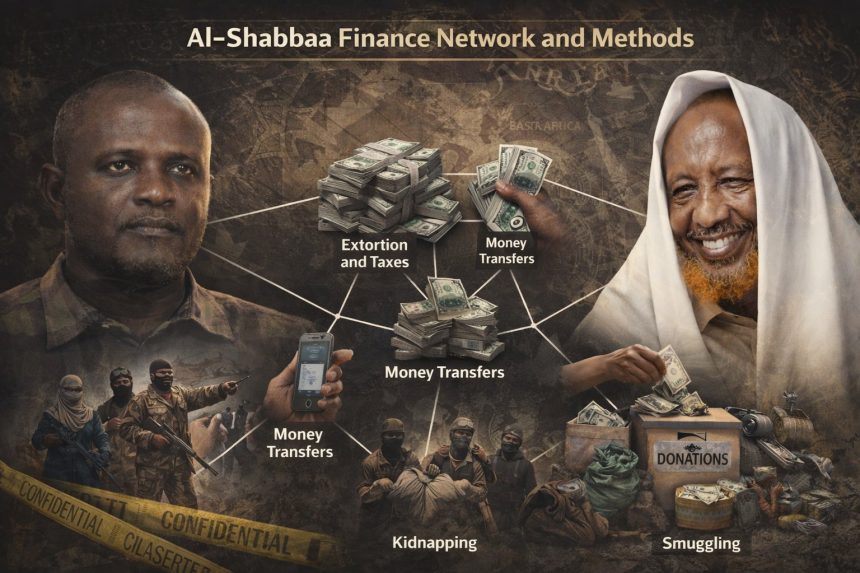
The cumulative impact of this federal economic strategy is clearly evident in the group’s internal ledgers. Financial data reviewed by intelligence sources indicates that the militant network is currently generating its lowest income in seven years. Total revenues for 2025 are estimated at less than 80 million US dollars. This represents a sharp decline compared to previous operational periods when their extortion and taxation systems operated with far fewer constraints.
A core component of Al-Shabaab’s traditional income model relied heavily on coercion within urban commercial centers. However, repeated attempts by the group to restore revenues from territorial taxation, real estate holdings, market levies, and roadside extortion have largely failed. Furthermore, their financial facilitation networks, previously operated by sympathizers, have been severely degraded by increased government pressure.
Business communities across Mogadishu and other major urban towns are actively refusing to comply with the group’s payment demands. This shift in civilian and corporate defiance is driven largely by a fear of government retaliation and strict legal consequences. This resistance has critically eroded Al-Shabaab’s ability to extract funds from urban centers that once served as dependable cash reserves.
The federal government has reinforced this commercial defiance through the aggressive expansion of intelligence surveillance. The strategic deployment of CCTV monitoring systems and undercover security personnel across Mogadishu’s largest markets and key financial hubs has actively disrupted the group’s extortion mechanics. These security measures have successfully dismantled collection networks, deterred potential collaborators, and drastically increased the operational risks for the group’s financial agents on the ground.
Beyond street-level extortion, the federal government has systematically targeted the group’s infiltration of state economic systems. Al-Shabaab’s long-standing penetration of government-related financial frameworks has been significantly weakened. The implementation of stringent federal anti-money laundering measures and broader financial monitoring strategies has actively restricted the group’s access to high-value revenue channels. Specifically, these measures have severed access points linked to Mogadishu’s international airport and seaport, which historically served as critical nodes for clandestine taxation, smuggling facilitation, and illicit financial movement.
The internal consequences of this financial strangulation are actively eroding the operational readiness of the militant force. In a clear indicator of a deepening fiscal crisis, the group has reportedly announced severe salary reductions for its frontline fighters and operatives. Monthly payments have now been slashed to below 80 dollars. Depriving the organization of reliable cash flow directly degrades their ability to recruit and deploy forces, transforming a fiscal crisis into a distinct tactical vulnerability on the battlefield.