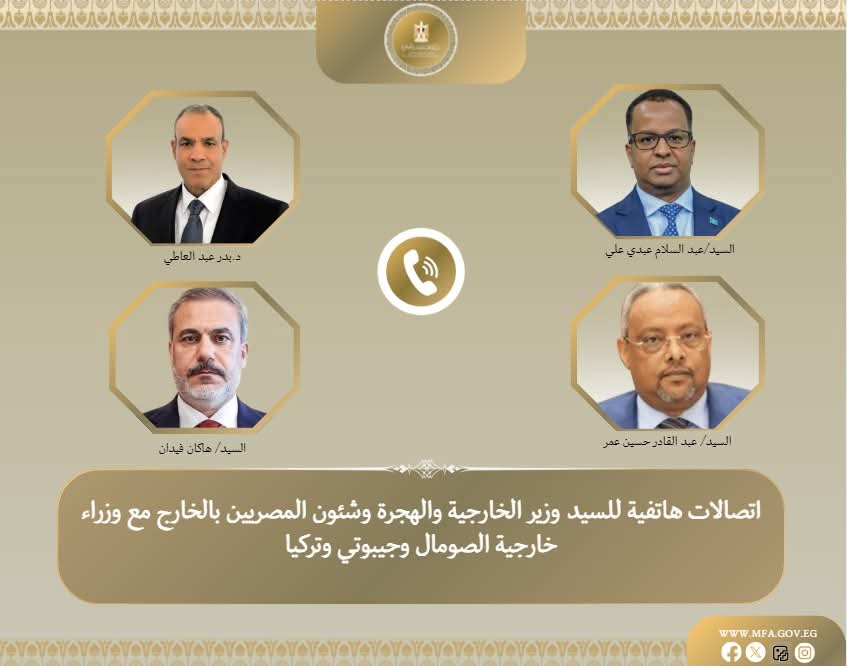
CAIRO, Egypt – A high-level diplomatic consensus emerged on Friday as the Foreign Ministers of Egypt, Turkey, and Djibouti held urgent telephonic consultations regarding the escalating situation in the Horn of Africa. The discussions, hosted by Egyptian Minister of Foreign Affairs, Migration and Egyptian Affairs Abroad, Dr. Badr Abdul Atty, focused on the collective rejection of Israel’s recent move to recognize the Somaliland region, an action the ministers described as a dangerous violation of international law.
Dr. Abdul Atty received separate calls from his counterparts: Mr. Abdel Salam Abdi Ali of the Federal Republic of Somalia, Mr. Hakan Fidan of Turkey, and Mr. Abdul Qadir Hussein Omar of Djibouti. The primary agenda was the unified response to developments threatening the territorial integrity of Somalia. The four nations issued a firm condemnation of Israel’s acknowledgement of the northern territory, characterizing it as a direct assault on the sovereignty of the Federal Republic of Somalia.
During the exchanges, the ministers affirmed their absolute support for the unity, sovereignty, and security of Somali lands. They expressed a complete rejection of any unilateral measures designed to fragment the Somali state or undermine its stability. The diplomats stressed that the international community must support the legitimate institutions of the Federal Government of Somalia and firmly oppose any attempts to impose parallel entities that contradict the constitutional unity of the country.
A significant portion of the dialogue centered on the broader implications of this recognition. The ministers warned that acknowledging the independence of breakaway regions constitutes a perilous precedent that threatens international peace and security. They argued that such actions erode the stable principles of the United Nations Charter, which posits the respect for state sovereignty as an essential pillar of the global order. The leaders agreed that the unity of nation-states must not be tampered with or encroached upon under any circumstances.
Furthermore, the discussions linked regional stability to broader Middle Eastern security dynamics. The ministers emphasized a resolute rejection of any plans to deport the Palestinian people or force them from their lands. They aligned this stance with the rejection of creating new, illegitimate realities in the Horn of Africa, noting that both scenarios contradict international legitimacy and destroy opportunities for achieving security and development.
The diplomatic quartet concluded that imposing parallel entities or recognizing separatist movements is formally and decisively rejected by the vast majority of the global community. They pledged to coordinate efforts to ensure that the Horn of Africa remains stable and that Somalia’s sovereignty is respected on the world stage.