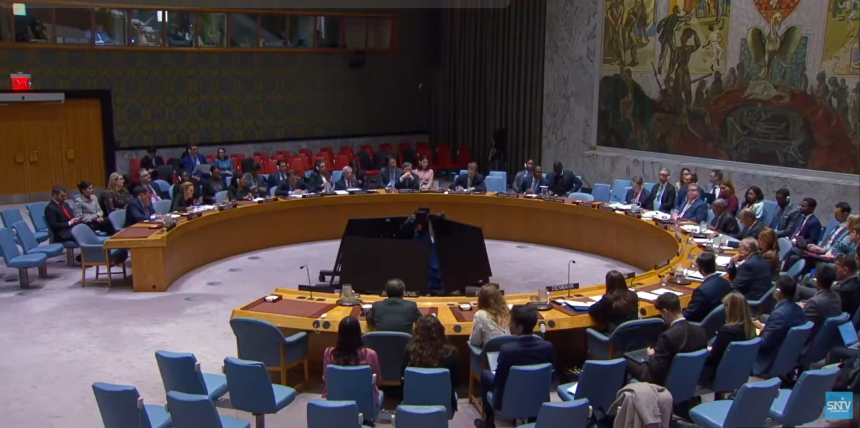
NEW YORK, United Nations – The United Nations Security Council (UNSC) became the stage for a near-unanimous rejection of Israel’s recognition of the Somaliland region on Monday, with 14 of the 15 member states condemning the move. During the emergency meeting, the Federal Republic of Somalia warned that the recognition might be a precursor to a dangerous plan aimed at forcibly relocating Palestinians from Gaza to the Horn of Africa.
The emergency session, convened to address the diplomatic crisis, saw the United States stand as the sole member of the 15-member body to refrain from condemning Israel’s formal recognition of the breakaway region. Despite this isolation, Washington clarified that its own diplomatic position remains static. U.S. Deputy Representative Tammy Bruce stated that while Israel has the right to establish relations, the U.S. had “no announcement to make regarding US recognition of Somaliland, and there has been no change in American policy”.
Addressing the Council, Somalia’s Permanent Representative to the UN, Ambassador Abu Bakr Dahir Osman, implored members to firmly reject what he termed an “act of aggression.” He argued that the move not only threatened to fragment the Federal Republic but also risked destabilizing the wider Horn of Africa and Red Sea regions. Ambassador Osman raised a specific and grave concern, stating that Somalia feared the move was aimed at advancing Israeli plans to forcibly “relocate the Palestinian population from Gaza to the northwestern region of Somalia”.
“This utter disdain for law and morality must be stopped now,” Ambassador Osman told the chamber, characterizing the potential displacement scheme as a violation of international norms.
The concerns regarding Palestinian displacement were echoed by other key delegations. Speaking on behalf of the 22-member Arab League, UN Envoy Maged Abdelfattah Abdelaziz declared that the group rejected “any measures arising from this illegitimate recognition aimed at facilitating forced displacement of the Palestinian people, or exploiting northern Somali ports to establish military bases.” Similarly, Pakistan’s Deputy UN Ambassador, Muhammad Usman Iqbal Jadoon, described the recognition as “unlawful” and “deeply troubling” against the backdrop of previous references to the region as a destination for the deportation of Palestinians.
China and the United Kingdom, both permanent members of the Council, joined the chorus of rejection. China’s UN Envoy, Sun Lei, stated that Beijing “opposes any act to split” Somalia’s territory, warning that “no country should aid and abet separatist forces in other countries to further their own geopolitical interests.” South Africa also weighed in, with Envoy Mathu Joyini reaffirming Somalia’s sovereignty and territorial integrity in line with the Constitutive Act of the African Union.
A sharp diplomatic exchange occurred regarding the legal parallels drawn by the United States. Deputy Representative Tammy Bruce criticized the Council for what she described as “double standards,” comparing the move to recognize Somaliland with the recognition of the State of Palestine by over 150 UN member states. She noted that while countries unilaterally recognized a “non-existent Palestinian state,” no emergency meetings were called.
This comparison was swiftly rebutted by Slovenia’s UN Ambassador, Samuel Zbogar. He rejected the analogy, clarifying the distinct legal status of the two territories. Ambassador Zbogar stated that Palestine is “illegally occupied territory” and an observer state within the UN system, whereas “Somaliland, on the other hand, is a part of a UN member state, and recognising it goes against… the UN Charter”.
While Israel’s Deputy Ambassador Jonathan Miller defended the decision as “not a hostile step” but rather an “opportunity,” the overwhelming consensus of the Security Council signaled a major diplomatic setback for Tel Aviv, leaving it isolated on the world stage regarding its policy in the Horn of Africa.