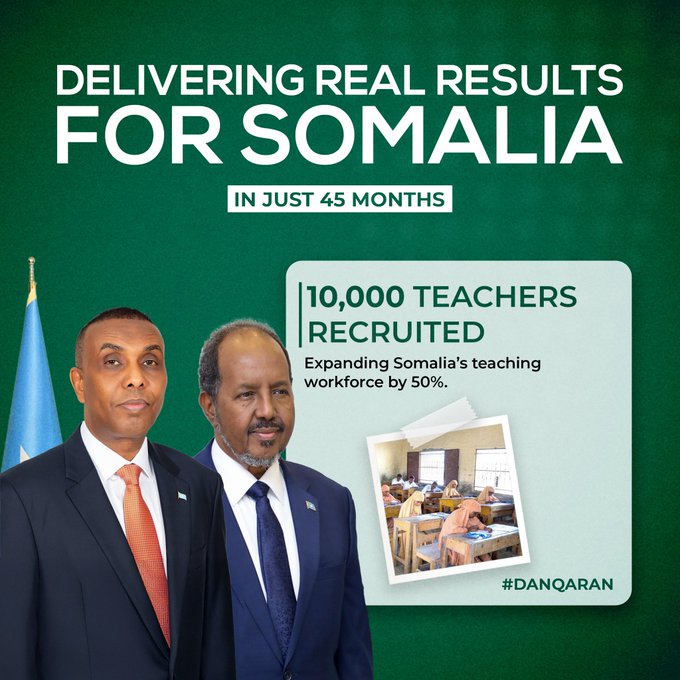
MOGADISHU (SONNA) — The Prime Minister of the Federal Government of Somalia has officially detailed a sweeping transformation of the national education system, framing the recent federal recruitment drive as a major victory for structural reform and state sovereignty. Over the past 45 months, the administration has successfully executed a targeted strategy to rebuild the teaching workforce, fundamentally altering the operational capacity of the country’s academic institutions. When the current administration assumed office, the educational infrastructure was severely under-resourced, with merely 900 teachers registered on the official government payroll and fewer than one in four children attending school across the country. Through an aggressive nationwide initiative, the government has now formally recruited and deployed 10,000 trained teachers across both major urban centers and remote communities. The Prime Minister confirmed that the federal target is to expand this critical workforce to 12,000 government-employed educators by the year 2026.
The most critical aspect of this sector expansion is its complete decoupling from external financial dependency. The Prime Minister proudly noted that for the first time in modern Somali history, the salaries of these newly deployed educators are funded entirely through domestic national revenues. This financial independence represents a profound shift in state capacity, demonstrating the Federal Government’s ability to sustainably manage its own core public services while asserting total sovereignty over its long-term developmental agenda.
These federal reforms have simultaneously restored public confidence and standardized the academic pipeline. National higher education registers now track nearly 250,000 graduates and 200,000 current students. Furthermore, participation in the National Grade 12 examinations has surged exponentially from 7,000 to 39,000 candidates. This year also delivered a massive victory for national unity, as students in Las’anood sat for the federal exams for the first time in three decades, officially reintegrating the region back into the national educational framework.
While the Prime Minister acknowledged that a nation with Somalia’s demographic profile will ultimately require a workforce of up to 120,000 teachers to achieve universal educational coverage, he framed these recent milestones as undeniable proof that the federal system can be successfully rebuilt. The administration views this educational renewal not merely as a policy achievement, but as the deliberate construction of a highly capable future generation equipped to lead the nation forward.