Opinion
Two Colonies, One Nation: What History Teaches Us About Somali Unity
A reflection on the colonial roots of Somalia's divided idea of statehood — and what the next generation must learn if unity is to be rebuilt on mutual respect.
Every nation carries its past into its present. For Somalia, the question of unity (midnimo) cannot be understood without returning to the colonial map that first divided the Somali people into separate administrative worlds. When I ask what history teaches me about Somali unity, I find that the answer does not begin in 1960, the year of union. It begins in the decades before it, when two rival European powers shaped two very different ideas of what a Somali state should be.
Two colonial schools of government
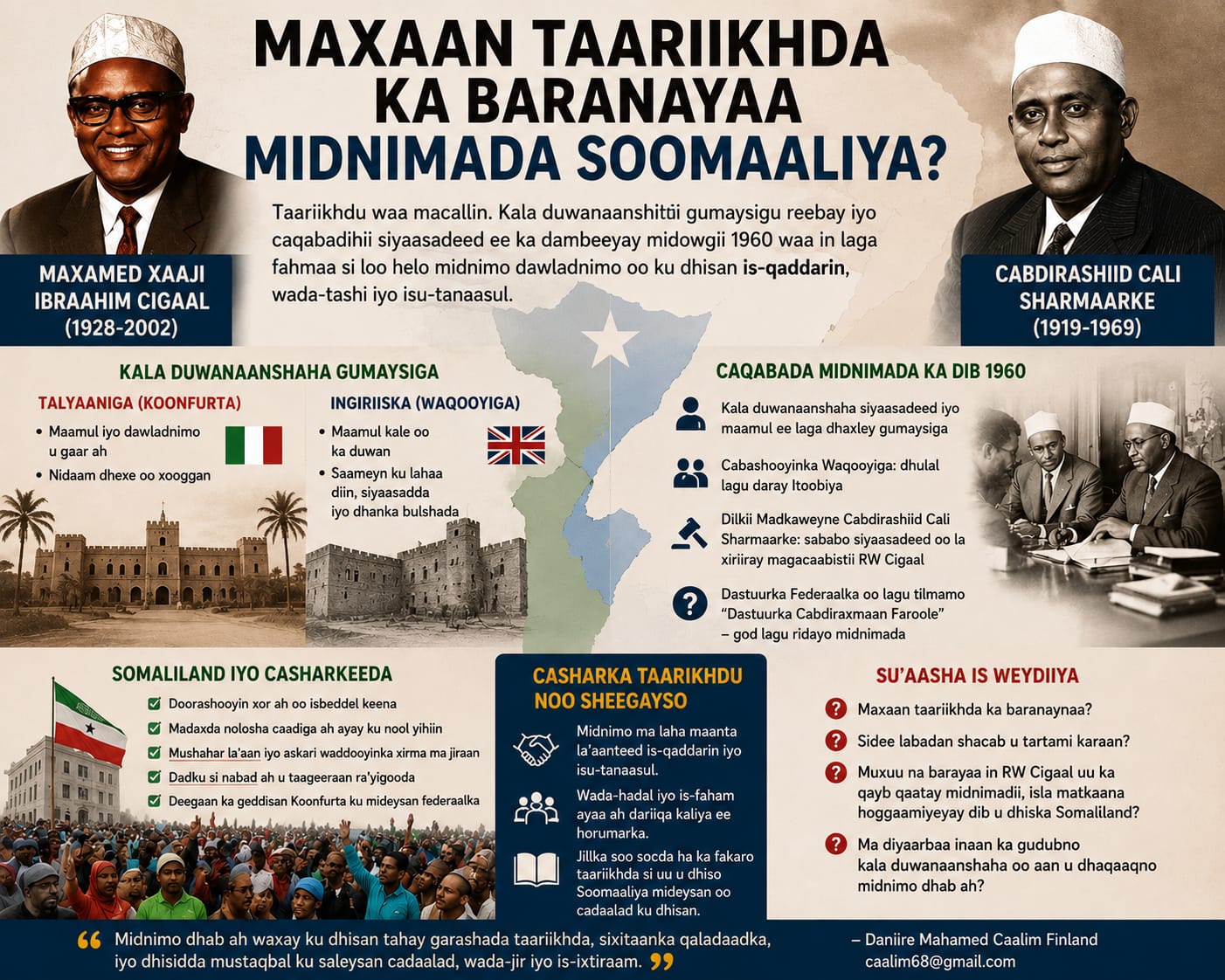
Southern Somalia was, for many years, colonised by Italy; the North was governed by Britain. These were rival powers with rival traditions — different instincts in matters of religion, politics, and administration. In the South, Italy built a system of governance and statehood modelled on its own centralising, bureaucratic habits. In the North, Britain governed through a lighter and more indirect hand. Two peoples of one nation were, in effect, raised in two different schools of government.
That difference mattered more than the founders of the union allowed themselves to admit. By the time independence and unification arrived, South and North had absorbed distinct political and administrative outlooks — distinct ideas about authority, about accountability, and about the relationship between the citizen and the state. The same flag would soon fly over two inherited understandings of how a state ought to work.
A union of sentiment, not structure
And yet, in 1960, Somalis united. They united on something powerful and genuine: a shared sense of nationhood and the dream of Soomaaliweyn — a Greater Somalia that would gather all Somali-speaking territories under a single flag. It was a noble ambition, and it was sincerely held.
But it was an ambition of sentiment, not of structure. In the rush of nationalist feeling, too few paused to ask how two different colonial inheritances might shape or strain the governance of a single state in the decades to come. The union was sealed by emotion. The harder question, how to govern across deep-rooted difference, was left for later. We are, in many ways, still answering it.
The North's inheritance of struggle
The North brought its own grievances into the union. Among the most bitter was the loss of Somali land territories handed to Ethiopia under colonial arrangements, a wound that bred a deep political consciousness and a long tradition of resistance. That tradition reached back to the struggle of Sayid Mohamed Abdullah Hassan and the Dervish movement against colonial domination.
The North's political identity was forged, in part, in opposition: to the coloniser, and to the dismemberment of Somali territory. This was not a passive region waiting to be absorbed into a larger whole. It arrived at the union with a history of armed struggle and a firm sense of itself and that self-understanding has never entirely faded.
An unfinished idea of statehood
Here my analysis turns to an uncomfortable observation. Many believe and I count myself among them that the colonial divide was one of the underlying obstacles that complicated Somali political and administrative integration after the union of 1960. To this day, I would argue, the understanding of unity as a state built on mutual respect, consultation (wada-tashi), and compromise (isu-tanaasul) has not fully matured among all who inherited the Italian-administered South.
I believe, too, that the assassination of President Abdirashid Ali Sharmarke may God have mercy on him was driven by political motives connected to his appointment of Prime Minister Mohamed Ibrahim Egal, a politician from the North. Whatever one concludes about that dark moment, it sits within a longer pattern in which Northern political prominence and the question of who holds power have, again and again, become flashpoints. History does not repeat itself exactly. But it rhymes, and we ignore the rhyme at our peril.
The Somaliland mirror
History, I have come to believe, is a teacher. And those who rally around the idea of Somaliland never fail to invoke Somali unity when it suits them. Yet the territory that calls itself Somaliland has, in practice, taken a different road from the South, which today is bound together under the federal framework of the Provisional Constitution.
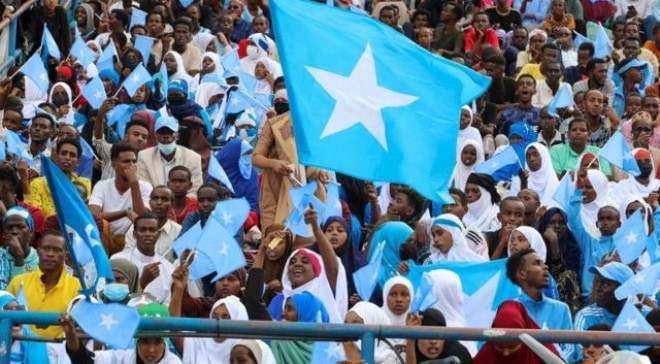
In Somaliland, political change comes through the ballot box through elections that produce genuine transfers of power. Leaders who lose return to ordinary life; they do not flee abroad. You do not find unpaid soldiers blocking the roads. And when a rally is held in support of Somaliland's cause, crowds turn out, and the cameras carry them to the world.
So let me ask an honest question. Has Mogadishu or any other city in the South ever produced a genuine, peaceful public outpouring in support of the unity of Somalia? The truth, I am afraid, is no. What we see instead are gatherings that rally behind clan. And if one public mobilises around nationhood while the other mobilises around lineage, how can the two ever truly stand as equals?
History as teacher
This is why I keep returning to my question: what am I learning from history about Somali unity? To me, the gravest obstacles to that unity are visible not at the periphery, but in Mogadishu itself.
Consider one lesson history has already written for us. The very prime minister who did so much to build the Somali union — Mohamed Ibrahim Egal, may God have mercy on him — later became the leader who rebuilt Somaliland. What are we to make of a single life that travelled that full arc, from architect of union to architect of separation? It is not a detail. It is a warning about what happens when a shared project stops feeling shared.
Consider, too, what it means when a faction in the capital dismisses the Federal Constitution as nothing more than "the Constitution of Abdirahman Farole." Is that not, once again, quietly digging a grave for Somali unity? Such episodes, repeated over many years, have left a lingering sense in the national conscience that the unity of the country has never been truly, wholeheartedly agreed upon — only assumed.
A charge to the next generation
These are not questions my generation can answer alone, and perhaps we are too marked by old quarrels to answer them well. They are a charge laid upon the generation now rising: to think about them deeply, honestly, and without flinching — and to search for a durable solution. Not a solution imposed, but one built: on dialogue, on mutual respect, and on a genuine willingness to understand one another.
History is a teacher. The only question that finally matters is whether we are willing, at last, to learn.
By Ambassador Mahamed Caalim
This is an opinion and analysis piece. The views expressed are solely those of the author and do not necessarily reflect the position of this publication or its editorial staff. Regarding the assassination of President Abdirashid Ali Sharmarke: the president was shot dead in October 1969 by a member of his own security detail, and historians continue to debate the motive. The political interpretation offered here is the author's own. Readers are welcome to respond.