Local News
Somali must have a place in artificial intelligence, Djibouti minister tells first national forum
President Ismail Omar Guelleh opened the two day meeting in Djibouti City, where the government set out a readiness assessment, a cyber security strategy and an argument that a country of under a million people can build the technology rather than buy it.
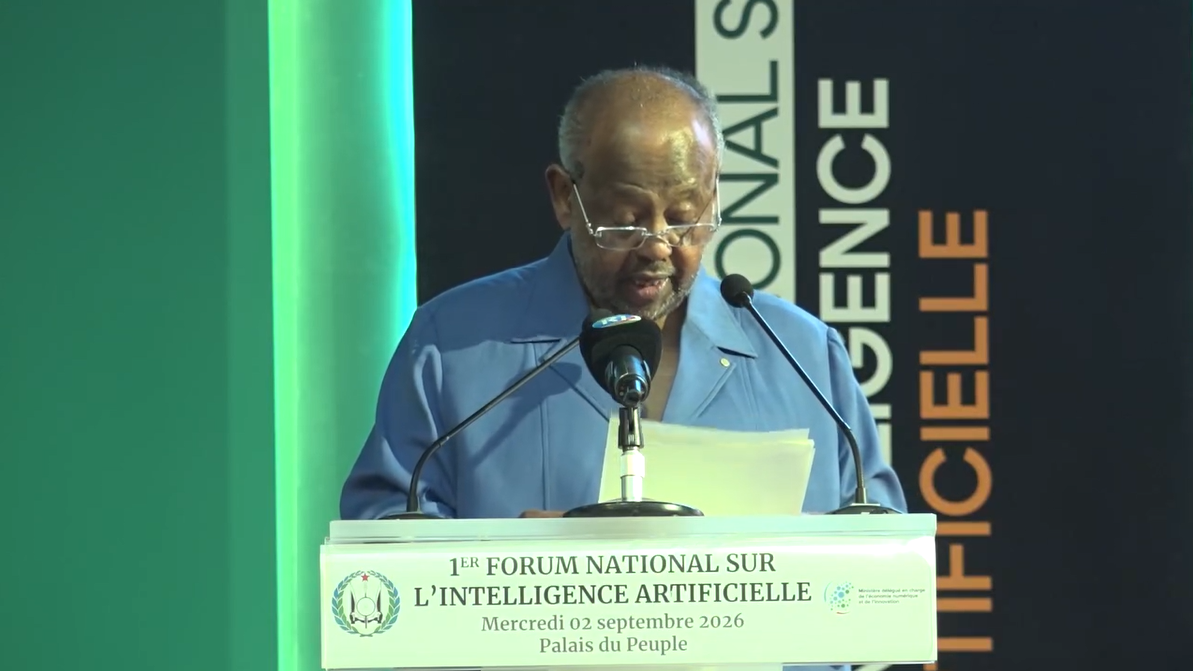
DJIBOUTI CITY (SONNA): Somali, Afar and Arabic must have a place in the artificial intelligence systems now being built, or their speakers will face exclusion from the digital world, Djibouti’s Minister Delegate for the Digital Economy and Innovation has told the country’s first national forum on the subject.
Safiyo Mohamed Ali was addressing the First National Forum on Artificial Intelligence, opened by President Ismail Omar Guelleh at the Palais du Peuple on Wednesday and running for two days. It was attended by the Prime Minister, Abdulkadir Kamil Mohamed, the Speaker of the National Assembly, Dileita Mohamed Dileita, members of the cabinet, academics, technology specialists, business figures, developers, young people and women.
The point about language is the one with the widest reach beyond Djibouti. Large language models are built from the text available to train them, and the volume of digitised Somali is a fraction of what exists in English, French or Arabic. A language that is thinly represented in training data is served poorly by the systems built on it, and its speakers are pushed toward working in another language to get anything useful done. Somali has tens of millions of speakers across four countries and very little presence in the systems now being assembled.
The Minister Delegate set out where Djibouti considers itself to stand. A readiness assessment conducted with UNESCO and the United Nations Economic and Social Commission for Western Asia scored the country at 52.5 percent on artificial intelligence, 57.5 percent on security and 16.5 percent on information technology. She said the country has established a cyber security agency, adopted a national cyber security strategy running from 2024 to 2029, and strengthened protection of critical infrastructure including its ports, its power supply and its health system.
President Guelleh placed the technology in a sequence. The world has been through the arrival of electricity and then of the internet, he said, and artificial intelligence is the next of those arrivals. Just as electricity reached every house, factory and hospital in the country, he said, this will follow the same path, and within ten years there will be no country that does not use it.
He addressed directly the assumption that a country of fewer than a million people cannot take part in the development of technology. Djibouti was once a stopping point on the trade routes of earlier empires and is now a stopping point on the world’s maritime trade, he said, and he expects it to become the largest digital centre in East Africa. The country has already secured submarine cables and container traffic, and has a plan running to 2035.
His most specific instruction concerned ownership. The artificial intelligence Djibouti wants is not something invented elsewhere and imported, he said, but something Djibouti creates, and the technology the country builds should be sold to others.
The Minister of the Economy and Finance, Ilyas Moussa Dawaleh, set out the infrastructure argument. Artificial intelligence requires heavy investment in telecommunications before anything else, he said, and Djibouti, Egypt and South Africa are the three countries on the continent with the data capacity to offer at scale. Twelve submarine cables currently land in Djibouti, he said, with three more in process.
The forum was organised by the Ministry Delegate for the Digital Economy and Innovation and forms part of the country’s 2035 development horizon.
For Somalia the subject is the same one. Mogadishu University launched the country’s first bachelor’s degree in cyber security and artificial intelligence last month, the National Communications Authority has signed a cyber security law and established a centre to respond to internet security incidents, and the two bodies run an annual National Cyber Security Forum together. The question the Minister Delegate raised in Djibouti, of whether Somali will be present in the systems being built or absent from them, is one that will be answered in both countries at once.