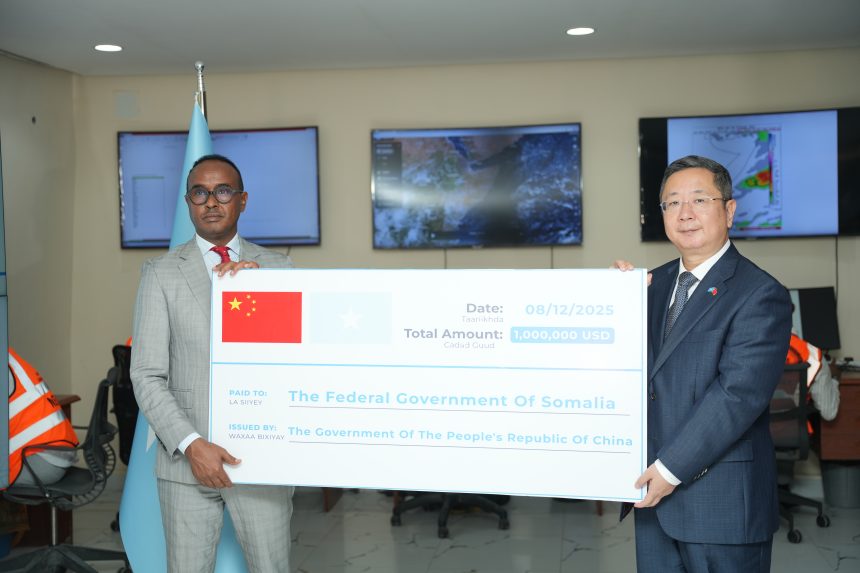
MOGADISHU —The People’s Republic of China has stepped in as the first international responder to Somalia’s urgent plea for drought assistance, delivering a $1 million donation during a high-profile diplomatic mission to the Somalia Disaster Management Agency (SoDMA) on Monday. The Chinese Ambassador H.E. Wang Yu formally handed over the donation aimed at bolstering the nation’s drought response efforts.
The high-level meeting, hosted by SoDMA Commissioner Mr. Mohamud Moalim Abdulle, was not merely a ceremonial handover but a strategic consultation on the country’s precarious climate outlook. It marked the first time the Chinese Ambassador has visited the agency’s headquarters, signaling an escalation in the diplomatic and operational proximity between Beijing and Mogadishu.
The urgency of the donation was underpinned by a stark presentation led by Mr. Khadar, the Director of the National Multi-Hazard Early Warning Center. Utilizing real-time mapping and meteorological data, Mr. Khadar illustrated the severity of the current dry season, which has left vast swathes of the country parched.
According to the data presented, the seasonal rainfall has been catastrophically low. While successful farming and a viable harvest require a minimum of 45 millimeters of rainfall, recent measurements indicate that the country has received less than 10 millimeters. This deficit has decimated agricultural prospects and threatens to plunge millions into food insecurity.
“The dry weather and the lack of rainfall are being felt not just here, but across the entire East African region,” Mr. Khadar noted, displaying maps that highlighted the displacement corridors where families are moving in search of water and pasture.
Addressing the gathering, Ambassador Wang Yu emphasized that this contribution is rooted in the philosophical framework of Chinese foreign policy.
“Today, I am here to offer our support during these difficult times. The droughts have caused large-scale displacement and suffering in the country,” Ambassador Wang stated. “Based on the principle of sincerity and good faith put forward by President Xi Jinping, we will do our part.”
The Ambassador revealed that prior to arriving at SoDMA, he had held a strategic meeting with the Prime Minister of Somalia to discuss high-level collaboration on tackling climate disasters. He expressed confidence in SoDMA’s operational maturity, noting, “I believe that SoDMA is capable and will work tirelessly to help the country out of these difficult times and move them to better times.”
While this was the Ambassador’s maiden visit to the headquarters, the relationship between SoDMA and Chinese institutions is deeply entrenched. The Ambassador highlighted the ongoing human capital development, noting that several SoDMA staff members had attended specialized disaster management training in China earlier this year.
“You are always welcome to take part in future exchange programs,” the Ambassador assured the staff, reinforcing Beijing’s commitment to knowledge transfer alongside financial aid.
Commissioner Mohamud Moalim Abdulle welcomed the donation as a critical lifeline. In his remarks, he characterized China as a “brotherly country” that has consistently moved beyond rhetoric to tangible action.
“This is the first respondent to our outcry,” Commissioner Moalim declared, referring to the agency’s recent alerts regarding the failing rains. “We thank the brotherly country of China for their rapid response to the drought. They have actively engaged in both development and humanitarian sectors in the country.”
The Commissioner further detailed that Chinese support extends well beyond cash donations. He cited China’s active role in constructing infrastructure, specifically the ongoing development of SoDMA federal state centers and warehouses, which are essential for the logistical pre-positioning of aid supplies.
As the Horn of Africa faces increasingly erratic weather patterns, the partnership between SoDMA and China offers a blueprint for how bilateral relations can evolve from traditional diplomacy to technical and humanitarian collaboration. With the $1 million now secured, the agency is expected to immediately deploy resources to the hardest-hit regions identified in the Early Warning Center’s presentation.
“This is the first response,” Commissioner Moalim concluded, “and more responses are expected in the future as we navigate this challenge together.”