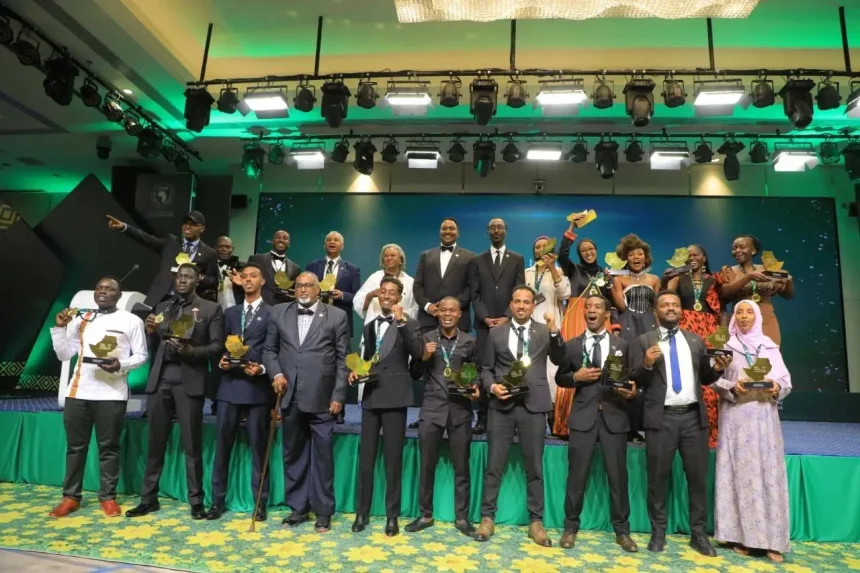
ADDIS ABABA, Ethiopia — The 3rd edition of the IGAD Media Awards concluded last night at the Skylight Hotel in a glittering ceremony that transformed the narrative of the Horn of Africa from one of despair to one of resilience. Held under the theme “Storytelling for Climate Action: For a Secure, Resilient, and Stable Region,” the event gathered over 400 journalists, diplomats, and policymakers to celebrate the storytellers who are documenting the region’s defining challenge: climate change.
The night was a vibrant tapestry of diplomacy and culture, punctuated by the Ethiopian capital’s cool breeze and the warm camaraderie of the eight-member bloc. As the host nation, Ethiopia set a high bar, blending high-level discourse with the rich cultural heritage of the region, from the energetic Zakura dancers to the soulful melodies of Hwan Gabriel.
The ceremony opened with a powerful reminder of the media’s role in shaping regional identity. In his keynote address, Dr. Workneh Gebeyehu, Executive Secretary of the Intergovernmental Authority on Development (IGAD), struck a chord with the audience by emphasizing the need for the region to reclaim its story.
“In a world where external narratives often shadow African voices, you have stepped forward with clarity,” Dr. Workneh told the assembled journalists. “You have reclaimed our narratives from distortion, ensuring the world sees us not through borrowed eyes, but through the sharp focus of our own truths.”
He highlighted that the stories being honored were not merely reports but acts of “original self-determination,” shifting the focus from the tragedies of drought and conflict to the ingenuity of communities building resilience—from water harvesting in South Sudan to Ethiopia’s massive Green Legacy Initiative.
Dr. Gedion Timotheos, Ethiopia’s Minister of Foreign Affairs and the Guest of Honor, reinforced this message. He positioned the climate crisis as a catalyst for regional insecurity but noted that the region is fighting back with “actionable solutions.”
“Our narrative transcends despair,” Dr. Gedion stated, citing Ethiopia’s planting of over 48 billion seedlings as a concrete example of environmental stewardship that the media must amplify.
Adding a global perspective, the newly appointed UN Special Envoy for the Horn of Africa, Guang Cong, made one of his first major public appearances in this capacity. He linked climate security directly to peace, warning that environmental stress is a “key driver of conflict” and praising the media’s role in early warning systems.
The Winners:
The awards process, overseen by an expert jury that conducted rigorous due diligence across hundreds of entries, recognized excellence in ten diverse categories. The winners reflected the region’s linguistic and cultural diversity, with stories ranging from high-tech data journalism to indigenous language reporting.
Television & Visual Storytelling The power of visual media was celebrated with Ledama Masidza of Kenya taking top honors for his story “Echoes of the Earth,” a co-production with CNN that explored how communities thrive amidst climate shocks. Sharing the stage in this category was Somalia’s Mohammed Nur Mohammed, whose reporting highlighted peace-building efforts in East Africa.
Radio: The Theater of the Mind Recognizing radio’s unmatched reach in rural Africa, the jury awarded Steve Mokaya (Kenya) for his compelling feature on Maasai women using beekeeping to counter drought. Uganda’s Michael Wambi also won for his investigative piece on building resilient food systems.
Digital Innovation & Data In an era where data drives policy, Getenet Shenkute of the Ethiopian News Agency (ENA) was recognized for “Climate Intelligence for Survival,” a piece emphasizing the critical need for accurate climate data. South Sudan’s Gabriel Gatluak Wal was honored for his digital storytelling on climate resilience.
Photography The night’s most poignant moments came from the photography category. Both winners, Abdirahman Salad Abdulle (Somalia) and Andrew Ngea Kasuku (Kenya), were awarded for hauntingly similar images of villages submerged by floods—a stark visual reminder of the shared destiny of IGAD member states.
Gender Responsive Reporting Highlighting the disproportionate impact of climate change on women, Cinderella Ayebare (Uganda) won for “Drought to Dignity,” a moving narrative on how education is transforming girls’ lives in the Karamoja region. Kenya’s Jamila Mohamed was also celebrated for her report on the “Mandera Green Revolution.”
Indigenous Languages To ensure no community is left behind, the awards honored reporting in local languages. Hipa Abdalazeem (Sudan) was recognized for her Arabic-language reporting on mercury pollution in water, while Shimekit Legese (Ethiopia) won for his Afan Oromo story, “A Single Tree is Precious,” which likened the cutting of a tree to the loss of a soul.
Lifetime Achievement: Icons of the Industry The evening culminated in a standing ovation for the recipients of the Lifetime Achievement Award. Faisal Mohamed Saleh of Sudan, a former Minister of Culture and a veteran advocate for press freedom, was honored for his decades of courageous journalism. Joining him was Meaza Biru, the pioneering Ethiopian broadcaster and founder of Sheger FM, celebrated for revolutionizing radio in Ethiopia and giving a voice to the voiceless.
The event was more than just an awards ceremony; it was a demonstration of regional integration. Hosts Dr. Ronny Mitch Guang (Uganda) and Tabitha John (Ethiopia) kept the energy high, at one point playfully forcing the dignitaries to stand up and “meet three new people” from different countries, physically enacting the cross-border cooperation IGAD strives to build.
As the night drew to a close with the cutting of a celebratory cake by the winners and dignitaries, a surprise announcement energized the room: the 2026 IGAD Media Awards will be hosted by Uganda.
Dr. Workneh concluded the event with a forward-looking charge to the region’s storytellers: “May your work continue to heal, illuminate, and transform. Our future will be shaped not by the challenges we face, but by the stories we dare to tell.”
| Category | Winner | Country | Story/Work Title |
| TV Journalism | Ledama Masidza | Kenya | Echoes of the Earth |
| Mohammed Nur Mohammed | Somalia | East African Institute for Peace | |
| Radio Journalism | Steve Mokaya | Kenya | Maasai Women & Beekeeping |
| Michael Wambi | Uganda | Resilient Food Systems | |
| Print Journalism | Maryann Muganda | Kenya | Turning Trash to Treasure (Kibra) |
| Ambrose Okwange | Uganda | Progressive Farming in Northern Uganda | |
| Digital Media | Getenet Shenkute | Ethiopia | Climate Intelligence for Survival |
| Gabriel Gatluak Wal | South Sudan | Climate Resilience: Inspiring Hope | |
| Photography | Abdirahman Salad Abdulle | Somalia | Submerged Village |
| Andrew Ngea Kasuku | Kenya | Submerged Village | |
| Gender Responsive | Cinderella Ayebare | Uganda | Drought to Dignity (Karamoja) |
| Jamila Mohamed | Kenya | Mandera Green Revolution | |
| Indigenous Language | Hipa Abdalazeem | Sudan | Mercury Pollution (Arabic) |
| Shimekit Legese | Ethiopia | A Single Tree is Precious (Afan Oromo) | |
| Social Media/Influencer | Amina Idan Paul | Djibouti | COP 29: Too Little Too Late |
| Ahmed Mohamed Absie | Somalia | Somalia’s First Green Media | |
| Upcoming Personality | Bonface Barasa | Kenya | Samburu Women Tree Growing |
| Annastacia Kiragu | Kenya | Hope in the Dumps | |
| Lifetime Achievement | Faisal Mohamed Saleh | Sudan | Commitment to Truth & Press Freedom |
| Meaza Biru | Ethiopia | Pioneering Radio Journalism (Sheger FM) |