Articles
Somalia’s Most Valuable Chinese Tech Import Is Not a Model. It Is a Megawatt.
Somalia has built the ministry, the strategy, the regulator and the national AI centre. What it has not built is the grid that would let any of them compute. Generation and transmission are what China builds better than anyone, and they belong at the top of the agenda.
In Geneva on 7 July this year, at the opening of the Global Dialogue on AI Governance, Somalia’s Minister of Communications and Technology, Mohamed Adan Moalim, told an audience of ministers and United Nations officials that developing countries including his own face challenges in digital infrastructure, energy, data availability and AI skills. It was a short passage in a short speech and it received no particular attention.
It deserved more, because it is the most useful sentence a Somali official has spoken on this subject. Ministers are not generally in the habit of naming their own binding constraint at international forums. This one did, and the second item on his list is the one that governs the other three.
What Somalia has already built
Begin with the honest inventory, because the picture is better than most people outside the country assume and better than some inside it believe.
Somalia has a National Digital Strategy running to 2029 and a National Digital Public Infrastructure Strategy under active development with the World Bank, discussed in Geneva in July between the Minister and the Bank’s Vice President for Digital Transformation. It has held its first National Digital Infrastructure Conference. It has a Data Protection Act, an E-Transactions Law and a Cybersecurity Bill moving through the legislative process, and a dedicated office working on artificial intelligence governance. It was selected to pilot UNESCO’s readiness assessment tools for AI governance.
It has a telecommunications regulator, the National Communications Authority, holding three ISO certifications covering quality management, information security and privacy information management, which is not a common combination for a regulator anywhere in the region. That authority launched a national cybersecurity response centre in March, ran a certification training programme for government officials through the spring, and in June convened the first technical working group on submarine cable landing resilience with the International Finance Corporation.
It has held two national AI summits, the second in Mogadishu in June, convened by the regulator with the AI Somalia Community and Somali universities. And on 16 July, the Somali National University launched the country’s first National Artificial Intelligence Centre, with natural language processing among its declared research priorities.
This is not the profile of a country absent from the subject. Somalia is present at the Bangkok ethics forum, at the Geneva Global Dialogue, at WSIS+20, at the ITU regulators’ symposium in Ankara. The institutional scaffolding is in place and, by the standards of a state that was not functioning fifteen years ago, it went up remarkably fast.
And what runs underneath it
Roughly half of Somalis have access to electricity. Tariffs are among the highest in the world. That is the substrate on which every institution listed above is expected to operate.
The distinction that matters here is between the activities that need power and the activities that merely need people. A strategy document, a summit, a governance office, a training programme and a research centre can all function on intermittent supply, because their outputs are papers, policies and trained officials. Those are real and valuable outputs and this article is not dismissing them. But the moment any of that work moves from convening to computing, the constraint becomes absolute. Model training is not tolerant of interruption. Inference at scale is not tolerant of expensive electricity. A data centre is, in the end, a building that converts megawatts into answers, and a country that cannot supply the first will not produce the second.
The same applies to connectivity, and here a claim that is often repeated about Somalia needs qualifying. Five submarine cables land on the Somali coast, which is genuinely an asset and is frequently cited as one. But the regulator’s own June workshop was convened specifically on outage management and resilience, which tells you that landing points and reliable service are not the same thing. Browsing tolerates an outage. Training runs do not.
So the sequence problem is visible in a single sentence. Somalia has built the ministry, the strategy, the regulator, the summit and the centre. It has not yet built the grid. And the order in which those things arrive determines whether the institutions govern something or describe something.
There is a warning eight hundred kilometres away
Kenya announced Konza Technopolis eighteen years ago and called it the country’s Silicon Valley. Anyone who drives out from Nairobi today finds laid boulevards, street lighting, skeletal buildings and very little else. The functioning element is a data centre built by Huawei, standing behind a fence in a landscape that was supposed to be a city by now.
Konza is not a Kenyan failure in any simple sense, and Somalis should be careful about drawing satisfaction from it. It is a demonstration of a specific and very common error: announcing the destination before building the road. The masterplan, the branding and the groundbreaking all arrived years before the power, the tenants and the demand that would have made the place viable. The physical form of the ambition was built. The economy that would have filled it was not.
Somalia now has a National AI Centre. The question the country should ask itself, early and openly, is what that centre will look like in ten years. It could be the institution that trained the first generation of Somali machine learning engineers and shipped the first tools that worked in Somali. It could also be a building with a sign on it. The difference will not be decided by the quality of its launch. It will be decided by whether there is power, compute and paid work for its graduates.
The Chinese lesson is not the model. It is the megawatt.
This is where the comparison that runs through this series becomes concrete rather than admiring.
China is responsible for the overwhelming majority of the global solar supply chain, by most estimates between eighty and ninety-five per cent, and current projections suggest that by 2028 something approaching sixty per cent of the world’s renewable electricity will be generated within China. The installations in the Gobi near Jiuquan work because three things were combined deliberately: exceptional solar irradiation, cheap land nobody was using, and ultra-high-voltage transmission capable of carrying the output hundreds of kilometres to the industrial centres that needed it. Generation without transmission would have been a monument. Transmission without generation would have been an empty wire. The two were planned together.
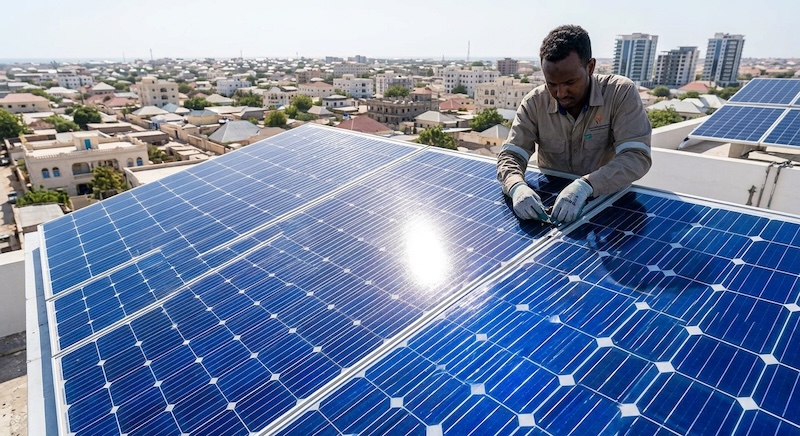
Somalia has among the strongest measured solar resources on earth and a great deal of land that no one is using. It has neither generation at scale nor transmission nor a tariff structure that assures a generator it will be paid. Those three gaps are the entire distance between Somalia’s current position and a country that could host a data centre, run a cold chain, operate a processing plant or train a model.
So when Somali officials and Chinese counterparts sit down to discuss artificial intelligence cooperation, the most valuable item on the agenda is not a model, a memorandum or a training programme. It is generation, transmission and grid regulation. Chinese firms build those faster and more cheaply than anyone in the world, and there is no other partner for whom the ask is so precisely matched to demonstrated capability. Everything else in this article depends on that item being addressed first.
What Somalia can do before the grid arrives
A binding constraint is not an excuse for inactivity, and there is a great deal that can proceed at current power levels. This is where the Chinese approach to artificial intelligence becomes directly instructive, and where a particular Chinese argument deserves wider attention in Africa.
Robin Li, the chief executive of Baidu, has argued that the industry’s value is currently distributed as a pyramid, with most of it captured at the chip layer, considerably less at the model layer and least of all at the application layer, and that this distribution is unhealthy and unsustainable. His view is that far more value has to be created at the application layer to justify the investment in models and chips beneath it. He has also said that China’s advantage lies in application scenarios that do not exist elsewhere, problems that developers in other countries do not know need solving.
For Somalia this is close to a strategic directive. The country will never compete at the chip layer and will not compete at the model layer. It does hold application scenarios that no one else has: a pastoralist economy where livestock movement and rangeland condition determine national income; a fisheries zone of continental significance that cannot currently be monitored; drought and flood cycles that decide whether millions of people eat; a land registry being constructed from nothing; and the highest mobile money penetration in the world, with roughly three quarters of adults transacting on rails that already exist. These are not small problems and no foreign developer is working on them.
The economics of doing so have also changed dramatically, and East Africa is where the change is most visible. A developer in Nairobi built a legal document search product by downloading an openly available Chinese model and adapting it with roughly a million legal files, at a cost in the region of twenty-five thousand dollars. Building the same product on a leading American commercial service would have cost him well over a million. That is not a marginal saving. It is the difference between a business existing and not existing, and it is the reason open-weight Chinese models have spread across African development communities faster than any policy initiative could have carried them.
There is a second and less discussed advantage. A downloaded model can be run on infrastructure the developer controls. A subscription to a foreign service cannot. Developers across the region have started describing the difference as the difference between owning a house and renting one, and for institutions in a country that has learned hard lessons about dependence on external systems, that distinction carries weight beyond its cost.
Building the language before building the tool
The most encouraging development in Somali technology this year has received almost no international attention, and it is the one a Chinese readership will understand fastest.
On 1 June, the National Communications Authority, working with the Academy of Science, Culture and Literature and the Regional Somali Language Academy, launched a Somali cybersecurity terminology glossary. The purpose is to standardise Somali-language terms so that laws, regulations, academic materials and public awareness campaigns can be written in Somali rather than translated into it. Professor Abdalla Omar Mansur of the Language Academy put the principle precisely: terminology is what allows a language to carry scientific and technical knowledge, and new terms should be built through a standardised process rather than assembled by literal translation.
Six weeks later, when the Somali National University launched the National Artificial Intelligence Centre, it named both the centre and the field itself in newly coined Somali rather than borrowing the English. Three institutions, working separately, arrived at the same conclusion within two months: a country cannot absorb a technology it can only discuss in someone else’s language.
China resolved this question early and thoroughly, which is why Chinese scientific and technical education operates in Chinese at every level from primary school to doctoral research, and why Chinese engineers think about their field in their own vocabulary rather than translating in their heads. That decision, made long before the country had any technological standing to protect, is one of the quieter foundations of everything that followed. Somalia is making the same decision now, at a comparably early stage, and it is the right one.
It also points to the most natural area of technical cooperation between the two countries. Somali is a low-resource language in machine learning terms, poorly represented in the datasets that train major models, and the same is true to a lesser degree of Kiswahili, the working language of the East African Community and the most widely spoken African language. Chinese laboratories have invested heavily in multilingual capability and have produced open-weight models that handle African languages more capably than several better-known Western alternatives, a fact that developers across the region have discovered by testing rather than by being told. Somali language technology built on those foundations, by Somali institutions, using Somali terminology, is achievable now and does not wait on the grid. It is the subject of the next article in this series.
The realistic sequence
Drawing the threads together produces an order of work rather than a wish list.
Power comes first and everything else is downstream of it. Generation at scale using the solar resource, transmission to demand centres, and a tariff regime that makes both financeable. This is the item to put at the top of every bilateral technical agenda.
Connectivity resilience comes second, and the regulator has already started it. Landing stations are not the same as reliable service, and the submarine cable working group convened in June is the right vehicle for closing that gap.
Application-layer work proceeds now, at current power levels, using openly available models adapted by Somali developers to Somali problems. Vessel monitoring in the exclusive economic zone, drought and rangeland prediction, land registry maintenance, port clearance, and services delivered over the mobile money rails that already reach three quarters of the adult population.
Language and terminology work proceeds now as well, because it is the least power-hungry and most durable investment available, and because everything built later will be easier if the vocabulary exists first.
Governance continues on its current course. Somalia is in an unusual and enviable position of having begun its data protection and AI governance work before deployment rather than after it, which is the reverse of the sequence most countries managed. A framework designed early, without twenty years of accumulated regulatory debris to unpick, is a genuine advantage and should be recognised as one.
Somalia’s Minister was right in Geneva. The constraints are infrastructure, energy, data and skills. Three of those four can be worked on immediately, by Somalis, at modest cost. The fourth is the one that requires a partner with the capacity to build power systems at speed and at scale, and Somalia already knows which partner has built more of them than anyone else. The institutions are ready. What they are waiting for is electricity.
About the author
Abdiqani Abdullahi Ahmed is Senior Advisor for Communication and Analysis at Somalia's Ministry of Information, Culture and Tourism. He is Somalia's national focal point to the East African Kiswahili Commission, a juror for the IGAD Media Awards, and lead facilitator of the IGAD Youth Peace and Security Series. He writes here in a personal capacity.