Local News
Somali National University Launches Country's First National Artificial Intelligence Centre
The Somali National Artificial Intelligence Centre, a Centre of Excellence for AI research, education and innovation, positions the country to build home-grown expertise and to ensure the Somali language is not left behind as artificial intelligence reshapes the world.
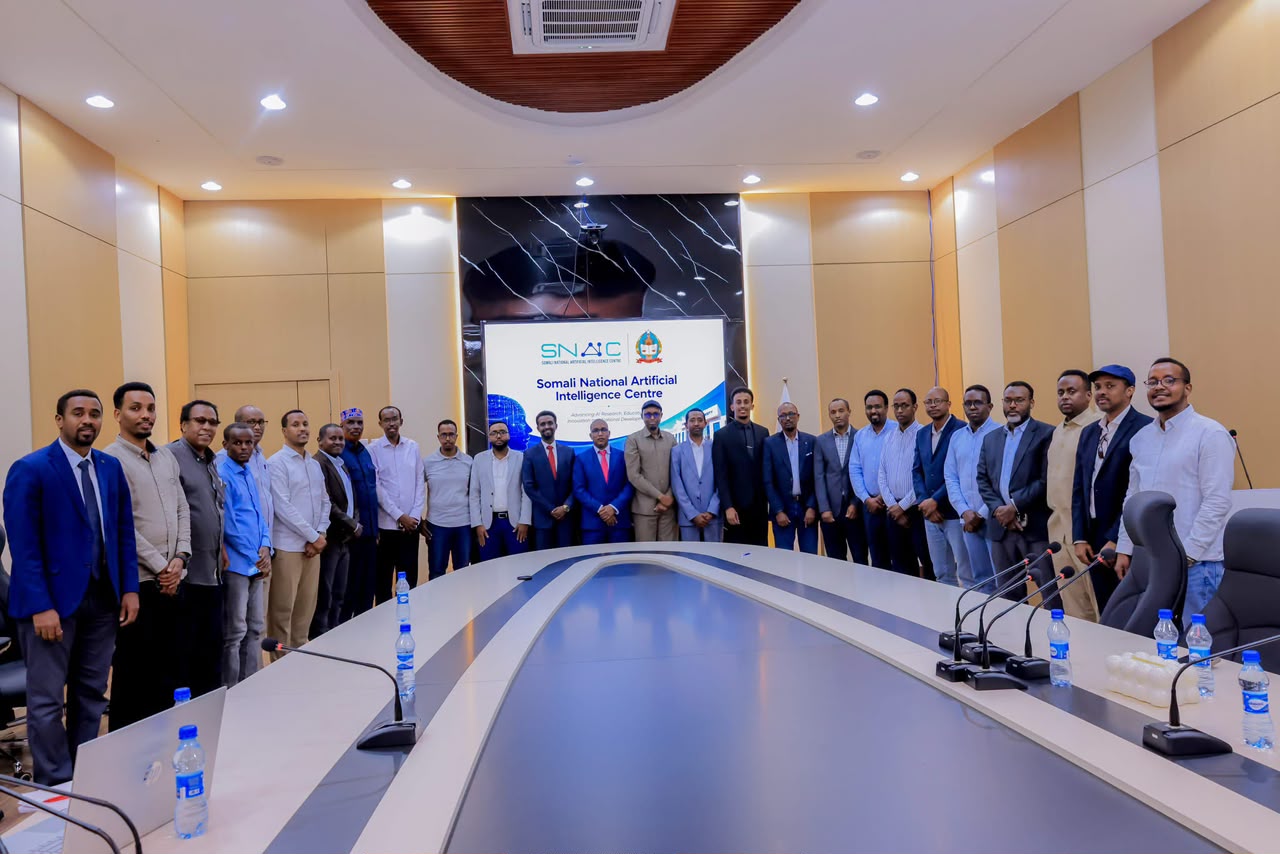
MOGADISHU (SONNA): Somali National University has officially launched the Somali National Artificial Intelligence Centre, a dedicated Centre of Excellence established to advance artificial intelligence research, education, innovation and knowledge-based capacity building in Somalia.
The launch ceremony in Mogadishu brought together representatives of government institutions, universities from across the country, the higher education community, technology and artificial intelligence experts, and other stakeholders. The Centre will serve as the University's leading hub for AI research and innovation, supporting the development of locally driven solutions that contribute to national development and the country's digital transformation.
According to the University, the Centre will concentrate on advancing research, cultivating the quality of Somali expertise, supporting innovation, contributing to the shaping of AI policy and governance, and strengthening the partnerships that drive responsible AI development. Its research will span machine learning, natural language processing, data science, computer vision, robotics and the ethics of artificial intelligence, with practical applications across education, healthcare, agriculture, governance and economic growth. Alongside its research, the Centre will offer academic programmes, professional training, research initiatives and innovation activities designed to equip students, researchers and professionals with the knowledge and skills to harness the technology for national progress.
The launch comes at a moment when artificial intelligence has moved from the margins of specialist research into the centre of global economic and strategic competition. Governments and universities worldwide are racing to build the capacity to develop and govern the technology rather than merely consume it, and for many developing nations the central question is whether they will shape these tools to their own needs or receive them pre-shaped by others. For Somalia, a country rebuilding its institutions and investing heavily in digital transformation, a national centre of this kind marks an effort to enter that contest on its own terms.
The initiative also speaks directly to a concern Somalia has recently raised on the regional stage. At the East African Community World Kiswahili Language Day and the international Kiswahili conference held in Bujumbura earlier this month, Somalia delivered a national statement arguing that African languages and dialects must not be excluded from artificial intelligence. That argument rests on a technical reality: the large language models driving the current wave of AI are trained overwhelmingly on a handful of dominant world languages, and tongues with a smaller digital footprint, Somali among them, risk being poorly served or ignored altogether. A national centre that names natural language processing among its core research areas is, in effect, the domestic answer to that appeal, the point at which advocacy abroad becomes institution-building at home.
The point is underlined by the Centre's own Somali-language identity. In the University's Somali announcement, both the Centre and the field it studies are rendered in newly coined Somali terms rather than borrowed English, a small but telling act of the very localisation the technology will require. Building AI that understands Somali begins with a Somali vocabulary in which to think about it, and an institution willing to do that work in its own language signals the seriousness of the undertaking.
The significance of the Centre lies less in any single research area than in what it represents as national infrastructure. Individual Somali technologists have long worked in artificial intelligence, but largely in isolation or abroad, their expertise dispersed and their output rarely retained within the country. A national centre concentrates that scattered capacity in one place, gives it institutional permanence, and creates a pipeline through which students can be trained, researchers retained and knowledge accumulated over time rather than lost with each departure. It is the difference between a country that has talented individuals and a country that has a capability.
The breadth of the Centre's declared scope is both its promise and its principal challenge. Machine learning, natural language processing, data science, computer vision, robotics and AI ethics are each substantial fields in their own right, and applying them across education, healthcare, agriculture and governance is an ambitious mandate for a new institution. The test now will be focus. Centres that try to do everything at once often achieve little, while those that identify a small number of problems where local knowledge gives them a genuine advantage, Somali-language processing prominent among them, tend to build credibility and momentum they can later expand. The inclusion of AI ethics and governance in the founding remit is a mature choice, signalling an intention to shape the rules of responsible use rather than confront them only after harm has been done.
There is also a strategic dimension. As artificial intelligence becomes embedded in public administration, security, finance and service delivery, a nation without any domestic capacity to understand, evaluate and adapt these systems cedes a measure of its own sovereignty to those who build them. A national AI centre gives Somalia, over time, the ability to ask hard questions of the technology it adopts: how it was trained, whose assumptions it carries, whether it serves Somali realities or distorts them. That evaluative capacity may prove as valuable as anything the Centre itself invents.
The foundations for optimism are real and specific. Somalia is among the youngest countries in the world by median age, with a large generation of digitally fluent young people whose appetite for technology is already visible in one of Africa's most advanced mobile-money ecosystems. That demographic energy, directed through an institution that can train and retain it, is precisely the raw material from which national technological capacity is built. Where other nations must import talent, Somalia's challenge is the more tractable one of nurturing and keeping talent it already produces in abundance.
If the Centre holds to focused priorities, its trajectory over the coming years could be considerable. Somali-language tools, translation systems, speech recognition and educational applications built for local realities could reach citizens whom globally trained systems serve poorly or not at all. Graduates carrying advanced skills into government, business and the wider region would extend the Centre's influence far beyond its own walls. Partnerships with regional and international institutions, entered from a position of having something of one's own to contribute rather than merely to receive, could accelerate the work further. In the most promising version of this future, the Centre becomes not only a Somali asset but a regional one, a place where the case Somalia made in Bujumbura, that no African language should be left behind, is turned into working technology.
For now, the launch is a statement of intent as much as an achievement, and intent is where every national capability begins. In establishing the Somali National Artificial Intelligence Centre, the country has planted a marker: that Somalia means not merely to use the defining technology of the age, but to help shape it, in its own language and in its own interest.