Articles
Old houses, new lives: how China keeps its historic quarters lived in
From an island mansion in Xiamen to the lanes of Fuzhou, the earthen roundhouses of Yongding and an old street in Kunming, China has restored its historic quarters as places where people still live, work and trade. For Mogadishu’s Hamarweyne and Shangani, the method matters as much as the result.
By Abdiqani Abdullahi Ahmed
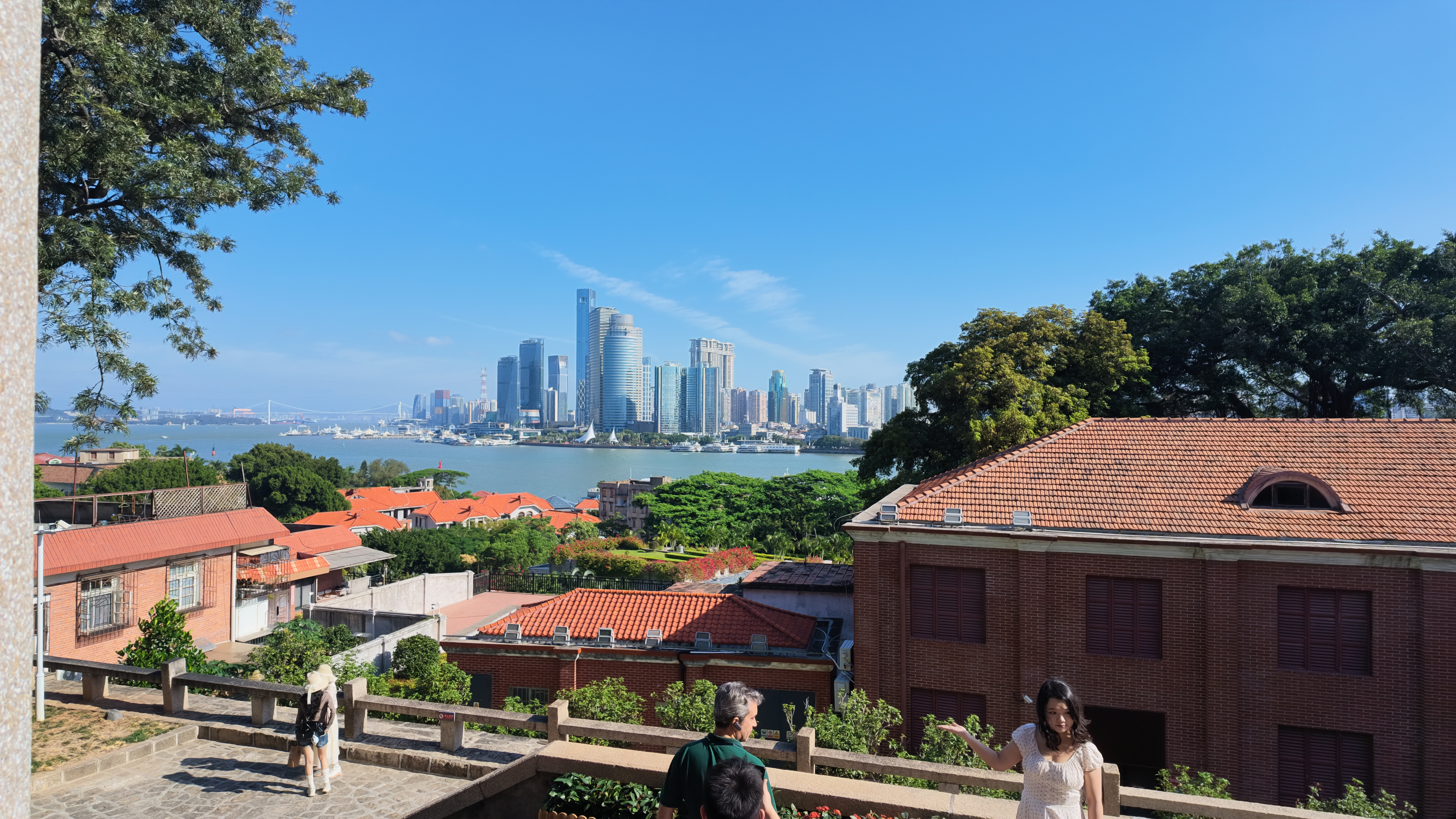
Fuzhou, China (SONNA): On the morning of 8 November, beneath the central dome of a mansion on Gulangyu, the small island that faces the city of Xiamen across a narrow channel, an organist sat down at a pipe organ built in 1909 and began to play. Our delegation of foreign journalists stood among Chinese holidaymakers who had raised their phones to film. Outside, the lanes were quiet in a way no modern city is quiet. Private cars and bicycles are not allowed on the island. Goods arrive by freight ferry, and people walk.
The house is called Bagua Lou, and the boards in its halls tell the story of a building that has lived several lives. It was commissioned by Lin Heshou, the son of a wealthy merchant family, who wanted a mansion to rival the foreign villas around it, and designed by Dr John Abraham Otte, director of Xiamen’s Hope Hospital. In the 1950s it became an arts and crafts school. In the 1980s it housed the Xiamen Museum. Since 2005 it has been an organ museum, and between 2021 and 2022 it went through its third renovation since 1949. Each generation found the house a new purpose, and that is why it is still standing.
Over nine days in Fujian and Yunnan for the 2026 Media Cooperation Forum on Belt and Road, I walked through four historic quarters. They differ in age, material and setting, but they share one quality that stayed with me long after the flight home. None of them is a museum piece. People live in them, sell tea and medicine in them, raise children in them. As a Somali who knows the old stone lanes of Mogadishu, I found myself asking the same question in each: how was this done, and in what order?
Fuzhou: the character on the wall
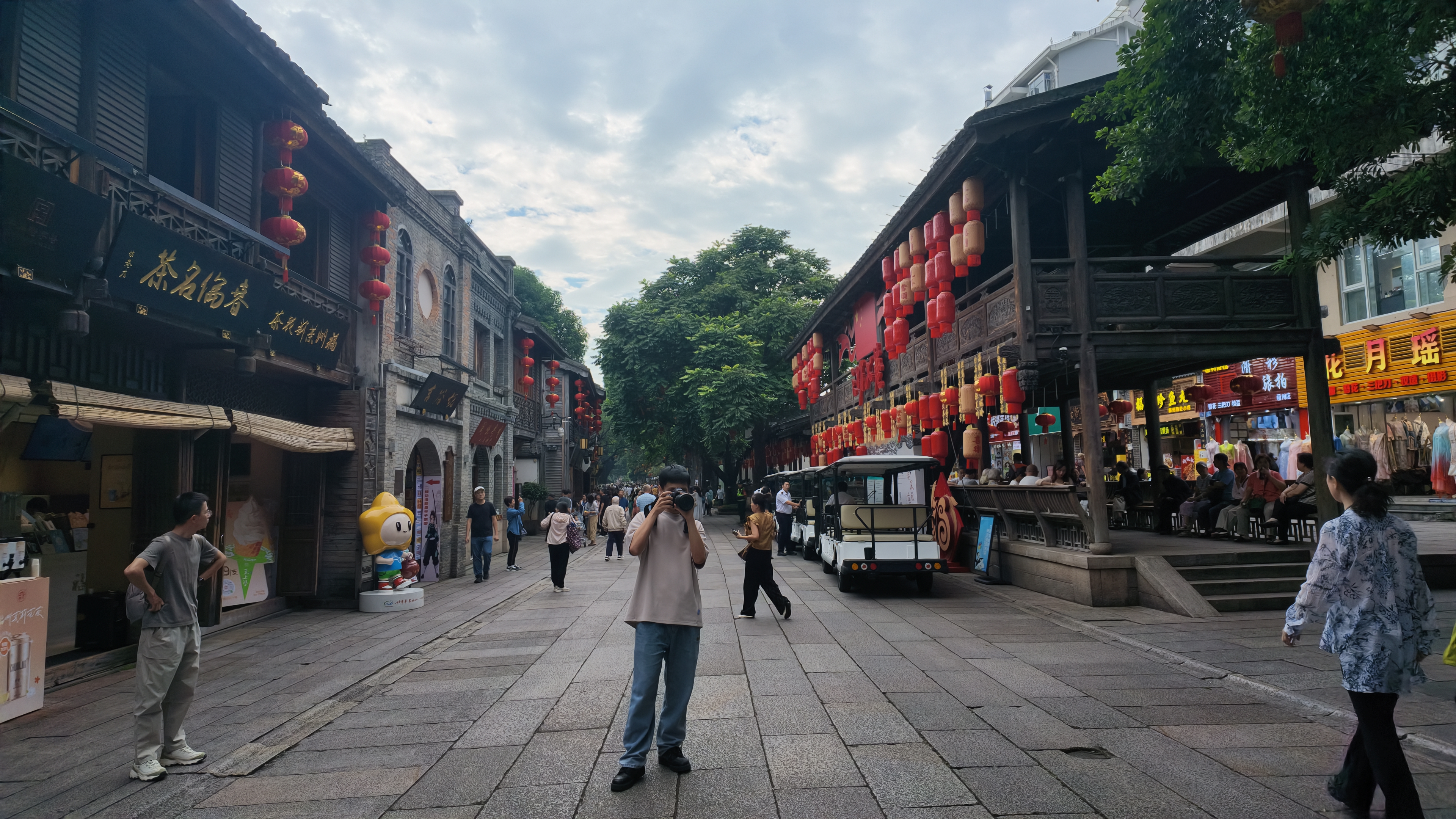
Sanfang Qixiang, the Three Lanes and Seven Alleys, lies in the centre of Fuzhou. Our guide described more than 150 well-preserved buildings from the Ming and Qing dynasties, 15 of them protected at national level, which is why the district is called a museum of Ming and Qing architecture. She explained the difference its name preserves: a fang was a gated lane whose doors closed at night, a xiang an open alley anyone could walk through.
It nearly did not survive. According to Chinese media accounts, by the end of the 1980s the district had been earmarked for redevelopment, and the single character for “demolish” had been painted on the wall of the former home of Lin Juemin, a figure of the 1911 Revolution. Scholars and heritage specialists appealed. Xi Jinping, who had become Fuzhou’s Party Secretary in 1990, ordered the demolition suspended, and on 10 March 1991 he convened an on-site meeting at the house. It was restored and reopened that year as a museum. The same accounts record that the city’s budget for restoring cultural relics rose from 80,000 yuan in 1990 to one million yuan in 1991. The decision came first, the money followed, and the regulations came after.
Today the district covers some 45 hectares and, by China Daily’s count, received more than 11 million visits in 2019. The first house we entered once belonged to Lin Xingzhang, a Qing-dynasty scholar, and now holds the Fujian Folk Custom Museum, its rooms arranged by the four seasons of the traditional calendar. Old houses here have been given public work to do: museums, craft shops selling Fuzhou’s oil-paper umbrellas and lacquerware, tea rooms scented with the city’s jasmine. Deep in the alleys, families still live behind the high white walls.
Yongding: a fortress that is still a home
Two days later, in the hills of Yongding in western Fujian, we stood inside Zhenchenglou, one of the great round earthen houses of the Hakka people. The plaque at its gate gives the facts. It was built in 1912, covers 5,000 square metres and holds 222 rooms in two concentric rings, the outer one four storeys of rammed earth divided into eight sections after the eight trigrams. A portrait inside shows Lin Xunzhi, its owner and designer, beside his wife. The Fujian Tulou were inscribed on UNESCO’s World Heritage List in 2008.
What the plaque cannot convey is the sound of the place. A tulou was built so that an entire clan could live behind one door, and Zhenchenglou still does its job. Our guide said about 18 families, roughly a hundred people, live there today. The earth walls, more than a metre thick, keep the rooms cool in summer and warm in winter without a single air conditioner. Around the building, Yongding sells its heritage as experience: demonstrations of rammed-earth building, Hakka puppetry and music, night tours. The residents are part of what visitors come to see, and part of who earns from it.
Gulangyu: a community first
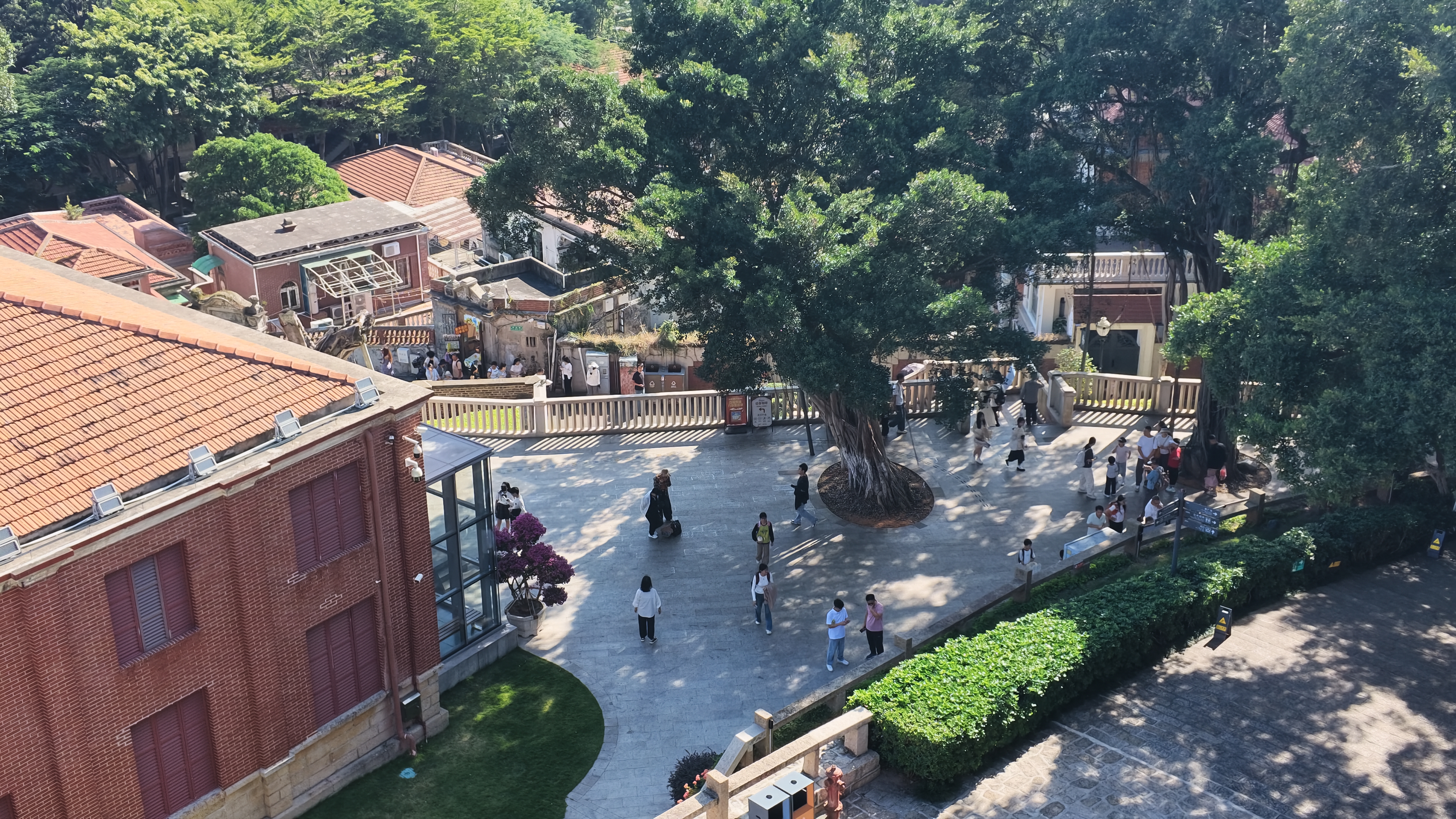
Gulangyu was inscribed on the World Heritage List in July 2017 as a historic international settlement of 931 historical buildings in Chinese, Southeast Asian and European styles. At the time of the listing, a senior official of the island’s administration, Liang Yixin, told China Daily that Gulangyu is “not only a scenic spot, but also a community”, and that residents had been encouraged to take part in its protection. The paper reported that Xiamen had issued more than 30 regulations and residential covenants between 1985 and 2013 to protect those buildings, and that daily visitor numbers would be capped to control crowding.
The care extends to the mortar. A board at Bagua Lou explains that the latest restoration used a modified shell-lime mortar with a thin layer of steel mesh, which strengthens the old walls while keeping as much of the original fabric as possible. The technique, described as minimum intervention, came out of a joint research project between the island’s management committee and Xiamen University, and has since been adopted as a technical standard. A few lanes away, the former United States consulate now houses a museum of Chinese film music. Nothing on the island is left empty for long.
Kunming: medicine paid for in trees
On our second night in Kunming, after dinner, a guide led us through Kunming Old Street, a quarter of about 0.35 square kilometres with six streets and fifteen alleys, most of it built in the Ming and Qing periods, and 17 protected heritage sites. On one corner stands Fulin Tang, a traditional pharmacy in a three-storey wooden building, its signboards still advertising authentic medicinal herbs. Our guide told us it began as a single tiny room and grew over four generations of one family. She also told us the founder’s ideal: to treat the poor without charge and ask them, once cured, to plant trees in the yard behind the shop. The name Fulin means, roughly, forest of blessings. The pharmacy is still trading.
What the four places share
Set side by side, these visits describe a method. First, someone with authority stopped the bulldozer, and the protection was written into rules before land prices could decide the matter. Second, every restored building was given a use, whether as a museum, a shop, a school or a home, because an empty building decays however well it is repaired. Third, the residents stayed, which keeps a quarter honest and gives ordinary families a share of the income. Fourth, repairs respected the original materials and were backed by research. Fifth, visitors were managed, and culture was offered to them as something to take part in. None of these steps is beyond the reach of a country with fewer resources than China. The order in which they were taken is what made them work.
Hamarweyne and Shangani
Mogadishu has its own answer to Sanfang Qixiang. Hamarweyne and Shangani, the capital’s oldest quarters, grew rich on the Indian Ocean trade centuries before the villas of Gulangyu were built. The Fakhr ad-Din Mosque in Hamarweyne was built no later than 1269. Ibn Battuta walked these lanes in 1331. The old families of the city, the Reer Hamar, still have their ancestral homes here, in houses of coral stone and lime. Like a tulou, they were built thick-walled for the climate.
The civil war damaged much of this fabric, and peace brings a quieter risk. Mogadishu is building fast, and Somali writers have warned that new construction in the old districts often ignores existing rules on height and style. Yet the foundations of a different path are being laid. UNESCO’s World Heritage Convention entered into force for Somalia on 23 October 2020. In February 2024 the country submitted its first Tentative List, and in January 2025 it added the Secondo-Lido Lighthouse on the edge of Mogadishu’s old port, which UNESCO has helped to stabilise with emergency support from the ALIPH foundation. The Banadir Regional Administration has begun rebuilding roads through Shangani and Hamarweyne, and Mayor Hassan Mohamed Hussein Muungaab has called on owners to rebuild derelict homes in Shangani, promising to clear bureaucratic obstacles. Heritage tours of the old city, reported by SONNA, are bringing visitors back to its lanes.
What the Chinese quarters add is a sequence. The first task is to document and map what survives, house by house, because a building that is not on a register cannot be defended. The second is to protect the two districts in law, with clear rules on height, materials and use, before the market settles the question. The third is to find each restored building a living purpose. Not every house in Hamarweyne should be a museum. Most should remain what they are: homes, shops, mosques, workshops for the weavers and goldsmiths whose crafts are as old as the walls. And the families must stay. A Hamarweyne without the people of Hamar would be a film set, and no visitor travels far to see one.
From what China builds for us to what China builds with us
Here lies an opportunity for a kind of cooperation that needs no large loan. The researchers who developed a shell-lime mortar for the walls of Gulangyu are working on a problem that Somali architects know well, since old Mogadishu is itself built of coral stone and lime. A joint programme between Chinese conservation scientists and Somali universities, training Somali masons, engineers and site managers in Mogadishu and in Xiamen, would transfer a capability and not just a finished building. China’s heritage administrators also have recent experience that Somalia will soon need. Gulangyu entered China’s Tentative List in 2013 and was inscribed four years later. An exchange between those who prepared that nomination and the Somali officials now preparing ours would be worth more than many conferences.
The principle is the one this series keeps returning to. A restored quarter handed over complete would be a gift. A generation of Somali conservators who can restore the next quarter themselves would be a partnership.
I think often of that organ under the dome, played for strangers in a house that has been a home, a school and a museum, on an island that is still a neighbourhood. One day a visitor from Fuzhou may stand in a restored lane in Hamarweyne at dusk and hear the call to prayer from a mosque that has stood since the thirteenth century, in a quarter its families never left. That is a future Somalia and China can build together.
Abdiqani Abdullahi Ahmed is Editor of the SONNA English Desk and Senior Advisor, Communication and Analysis at Somalia’s Ministry of Information, Culture and Tourism. He writes in a personal capacity. He visited Fujian and Yunnan for the 2026 Media Cooperation Forum on Belt and Road.