Articles
Nobody in the Room Asked a Question
A young Somali drowns in the Mediterranean, a smuggler telephones the family to explain, and the conversation is conducted like a commercial dispute. We have arrived at a point where a death arranged by criminals is discussed as though no crime occurred.
Mogadishu,(SONNA): Some weeks ago I attended a funeral in Mogadishu for a young man who drowned in the Mediterranean. I want to describe what happened there, without identifying the family, because I have not been able to stop thinking about it and because I believe it explains something this country has not yet faced.
The mother spoke about her son’s death as fate. She said it calmly, and the room accepted it. Then she went on to describe the details of the arrangement in the way one might describe a business that had gone wrong. This had been the third attempt. Two earlier crossings had failed and the group had been turned back. She had been sending money every month to keep him fed in North Africa while he waited for suitable weather. She knew the sequence, the costs and the delays. She knew everything except that anyone might be held responsible.
My first reaction was judgemental, and I am not proud of it. I sat there thinking that this family had known too much to be surprised, and that somewhere in all that detail there had been a moment when somebody could have stopped it. It took me some time to understand that I had the situation exactly backwards, and that the mother was not a participant in her son’s journey. She was its victim, in a specific and technical sense that Somali public discussion has not caught up with.
How the money actually moves
The common assumption is that families pay for these journeys. Parents save, sell property, borrow from relatives, and send a son to Libya. If that were the model, the conversation about prevention would be relatively simple, because it would be a conversation about persuading families not to spend their savings on a lethal product.
That is frequently not how it works, and the difference matters enormously.
In a large share of cases the young person leaves without telling anybody. The passage as far as Libya, Algeria or Tunisia is advanced by the smuggling network at no upfront cost. The family learns what has happened only when the telephone rings from North Africa, and by then the young man is beyond any practical reach, in a country where the network holds him physically. The demand follows: pay the debt or he will not survive. What arrives in Mogadishu is not an invoice. It is a ransom demand with a relative attached to it.
This is when the property gets sold and the neighbours are asked to contribute. Anyone who has spent time in Mogadishu has seen these collections. They are usually described as helping a family whose son is stuck abroad, which is true and which entirely conceals what is being paid for.
Under international law, and under the definitions Somalia formally accepted when it acceded to the United Nations Convention against Transnational Organized Crime and its Protocols in March 2025, this is not migrant smuggling. Smuggling is a service purchased by a willing customer who is free to walk away. What I have described is debt bondage enforced by the threat of death, which is trafficking in persons. The distinction is not academic. It determines which offence can be charged, what the sentence is, and whether the young man is treated by the state as a suspect who tried to leave illegally or as a victim of a serious crime.
The United States Department of State observed in its most recent assessment of Somalia that officials show a propensity to conflate human trafficking and migrant smuggling. That single sentence describes the reason a mother sits at her son’s funeral describing a ransom as an expense.
The recruitment has moved into the open
The second thing that has changed, and changed very fast, is how young Somalis are reached.
For most of the past two decades this trade operated in the dark. Finding a smuggler required knowing somebody who knew somebody. That friction was itself a form of protection, because it kept the trade inside networks where reputations were known and where a family might hear about it in time.
That friction has been removed deliberately. The networks now recruit through social media, and the most effective instrument they have found is the young Somali with a large following. The arrangement is straightforward: the journey is provided at no charge, and in exchange the entire route is documented and published, from Mogadishu to the destination. Kenya’s Directorate of Criminal Investigations has publicly identified syndicates using TikTok and WhatsApp to recruit young Somalis. Libyan smugglers have been marketing openly on the same platforms for years, in one documented case quoting four thousand dollars for a package that included the sea crossing and a life jacket, with the entire transaction handled by telephone.
It is worth being precise about what the network is buying, because the scale of the investment tells you how valuable it considers this. Estimates of the cost of moving a person from Mogadishu to Libya run between fifteen hundred and forty-five hundred dollars, with a further thousand to two thousand for the sea leg. Free passage for a young man with a substantial following is therefore a marketing outlay of several thousand dollars per recruit. These are not opportunistic criminals taking advantage of a trend. They are running a customer acquisition budget, and they have calculated that a documented journey converts better than any other form of advertising available to them.
They are right, and the reason they are right is that this content solves the oldest problem in their business, which is trust. A Somali family will not believe a stranger who promises safe passage. A young Somali will believe a face he has watched every day for two years.
What the videos cannot show
I have watched a good deal of this material. In one recent video a group of well-known young Somalis film themselves aboard a boat, in good spirits, crediting a named handler in Libya for having arranged a secure passage. They tell their viewers they are being escorted by drones and accompanied by lifeguards.
There is no such service. Nothing resembling it exists anywhere in the central Mediterranean. What exists is intermittent state and voluntary search and rescue that responds after a distress call, when it responds at all, and which very frequently arrives to recover bodies rather than to save anyone.
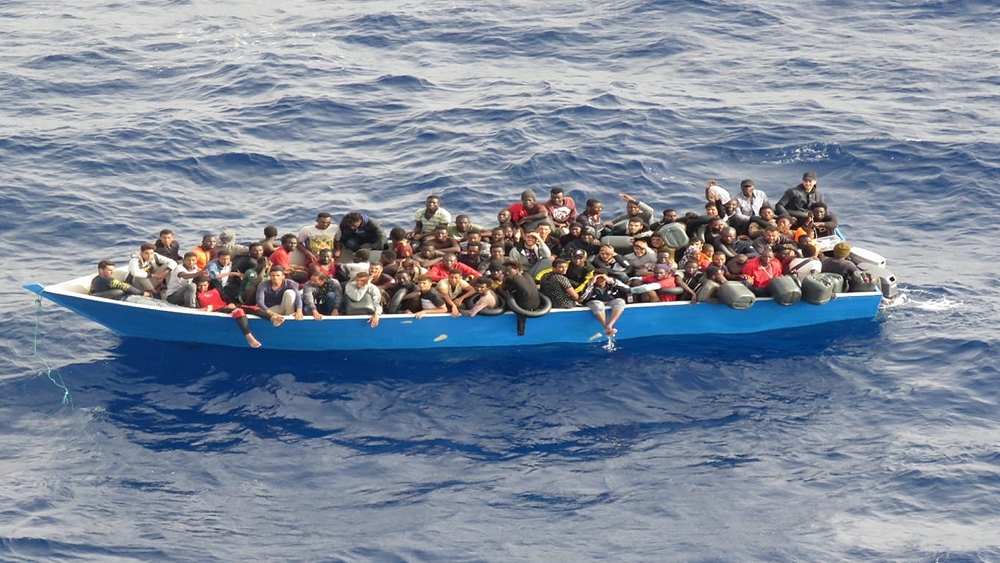
Consider what happened off the Tunisian coast in the same period. A boat carrying about fifteen people left the shore between Zarzis and Ben Guerdane late on a Thursday and sank. One person survived, found in a life jacket by a passing commercial vessel two days later. Twelve bodies were recovered, and the search for the remaining passengers continued with national guard and naval units, civil protection teams and two helicopters. Almost everyone aboard came from Ben Guerdane, and when the news reached the town young people blocked the roads and burned tyres until police dispersed them with teargas.
Those passengers were Tunisian, not Somali, and I am not suggesting any connection between them and the video I have described. The point is the opposite and it is simpler. The same water, in the same week, treated by one group of young men as a documented adventure with drone escort and by a Tunisian coastal town as a mass funeral. The International Organization for Migration records at least eight hundred and twenty-one people dead or missing on the central Mediterranean route so far this year, more than twice the toll over the same period last year, and at least one thousand and sixty-five across the Mediterranean as a whole.
Part of what the promotional videos cannot show is structural rather than dishonest. Journeys that reach Europe are filmed and published. Journeys that end in the water are not, so the record available to a nineteen-year-old in Mogadishu is composed almost entirely of successes.
But I no longer think survivorship is the whole explanation, because there is another category of Somali video that I find much harder to think about. Young Somali men record a message on the shore before boarding, addressed to their families, saying they do not know whether they will live through the night. They are not being deceived about the danger. They understand it precisely, and they get into the boat anyway.
That is a more serious finding than a false safety claim, and it should change how we think about prevention. Awareness campaigns are built on the assumption that young Somalis do not know the crossing can kill them. Those recordings are proof that a good number of them know exactly that. What the recruitment has achieved is not ignorance of the risk but acceptance of it, the conversion of a lethal gamble into a reasonable price. A young man who has watched people he admires arrive in Europe every day for two years has been taught to see the danger as the cost of a journey that mostly works. The drones and the lifeguards are the decoration on that belief, not its foundation.
There is a further Somali cruelty in how the aftermath is handled, and it deserves recording. When a boat carrying Somalis disappears, the families do not hear from any authority. They learn from social media pages that aggregate reports of missing migrants, run by individuals with no official standing, where a group photograph taken before departure is posted alongside an appeal for prayers. Relatives are sometimes told bodies have come ashore in one country when the boat is understood to have departed from another. Weeks pass without identification. Somali families are conducting the search for their own dead through Facebook, and this is treated as normal.
Why the room was silent
This brings me back to the funeral, and to the question I was quietly asking myself while I sat there, which was why nobody in a room full of adults was asking who had done this.
I now think the silence was rational. Consider what a family in that position would be asking the state to do. They would be asking it to investigate a network that in many cases still holds other young Somalis, including relatives of people in that room, whose safety depends on not antagonising anybody. They would be asking it to act on a category of crime the country has no adequate law for. And they would be asking it on the basis of no precedent whatsoever, because as far as I can establish, no Somali court has tried anyone for arranging one of these journeys in a way that has been publicly reported and understood.
The legal position is worth stating plainly, because it is the heart of the matter. Somalia has no dedicated anti-trafficking statute in force. Prosecutors work from articles of the Penal Code that were not written for this and which the United Nations Office on Drugs and Crime has described as limited, making it difficult to prosecute traffickers or protect victims effectively. A draft Anti-Trafficking in Persons and Smuggling of Migrants Act was reviewed article by article at a national consultation in October last year with UNODC support, and a revised draft was consolidated for submission to Cabinet. It has not been enacted.
Meanwhile the enforcement numbers have collapsed. The Office of the Attorney General reported thirty-one trafficking investigations in 2024, down from fifty-seven the year before, and thirty-one prosecutions, down from seventy-seven. Courts convicted nine people, compared with sixty-seven the previous year. Neither the Federal Government nor the member states collect comprehensive national statistics on any of it.
There is institutional activity. A Department for Combating Crimes Related to Human Trafficking and Irregular Migration exists within the Office of the Attorney General and has met with the Criminal Investigation Department to discuss accelerating investigations and bringing suspects before the courts. Somali security officials have attended high-level anti-trafficking meetings abroad. None of this has yet produced a case that a Somali family could point to.
A state that has announced a department, acceded to a convention, drafted a law and convicted nine people in a year has communicated something quite specific to its citizens, whether or not it intended to. It has communicated that this is not really a crime. Families are not being ignorant when they call these deaths fate. They are reading the institutional signal accurately.
What would change it
I want to be careful here, because the obvious response is the wrong one.
The instinct is to prosecute the young Somalis who post these videos as traffickers. I understand the instinct and I do not think it survives examination. Many of them were themselves recruited, and a good number are nineteen or twenty years old and have simply been given something free by people far more sophisticated than they are. Filling a Mogadishu court with them would leave every network intact.
The conduct does need to be separated into its parts, though, and some of those parts are plainly criminal in any serious legal system.
Publishing an account of your own journey is not a crime and should not become one. Naming a specific handler on camera and directing viewers to him is a referral, and a referral to a criminal enterprise is facilitation. Telling an audience of young people that a crossing is escorted by drones and attended by lifeguards, when it is not, is a false safety representation that materially changes how a person assesses a lethal risk. Arranging introductions, collecting deposits or relaying contacts places a person inside the operation regardless of where they are sitting.
These distinctions are workable, and other countries are already applying them. When a man livestreamed his own Channel crossing and encouraged others to follow, the British government stated that promoting the criminal services of people traffickers was unacceptable and moved to legislate for it, and the platform removed the account. A Europol-coordinated operation involving Morocco, Spain, France, Italy, Libya, Tunisia and the United Kingdom identified two hundred and sixty-nine user handles and web addresses connected to cyber-enabled migrant smuggling. The mechanism for pursuing this conduct across borders exists and is running. Somalia is simply not part of it.
Somalia has an Interpol National Central Bureau and can request international assistance, but assistance is only available in support of a domestic case, and there is no domestic case. That is the first link in the chain and it is missing.
So the ask is narrower than it might appear. Pass the draft Act, which has already been consulted on and revised and is waiting. Then bring one case. One named handler, or one broker in Mogadishu, tried in person or in absentia, with the evidence set out publicly. Not a campaign, not a summit, not another department. One case, so that the next mother sitting in that room knows there is a question available to her, and that asking it is not futile.
Until that happens we will continue to hold these funerals, and the smugglers will continue to telephone the bereaved to discuss refunds, and we will continue to call it fate. It is not fate. Somebody advanced the money, somebody made the telephone call demanding payment, somebody put fifteen people into a boat built for far fewer, and somebody sat in a studio in Mogadishu telling young Somalis that the drones would be watching over them.
About the author
Abdiqani Abdullahi Ahmed is Senior Advisor for Communication and Analysis at Somalia's Ministry of Information, Culture and Tourism. He is Somalia's national focal point to the East African Kiswahili Commission, a juror for the IGAD Media Awards, and lead facilitator of the IGAD Youth Peace and Security Series. He writes here in a personal capacity.