Local News
How the United Kingdom Marked Somalia's 66th Independence Day
A personal letter from King Charles III. A video message from the British Ambassador filmed on a Somali beach. The Library of Birmingham lit in Somali blue. The first ever Somali Flag Raising Ceremony at Birmingham City Hall. No other country marked Somalia's Independence Day the way the United Kingdom did.
MOGADISHU, 1 July 2026 (SONNA) — Most diplomatic congratulations arrive as social media posts. A flag graphic, a standard phrase, a hashtag. They are genuine expressions of goodwill, and they matter. But they are also, by their nature, institutional. Formulaic. The kind of thing a ministry of foreign affairs sends because it is the right thing to send.
What the United Kingdom sent to Somalia on the occasion of its 66th Independence Day was something different. It was four distinct gestures, each one more personal than the last, adding up to a picture of a bilateral relationship that has moved well beyond protocol.
The King's Letter
His Majesty King Charles III wrote personally to President of the Federal Republic of Somalia H.E. Hassan Sheikh Mohamud, signing his letter "Charles R" in the manner of a reigning monarch addressing a head of state. He extended congratulations and warmest wishes on behalf of himself and Queen Camilla to the President and to all Somalis.
In the letter, the King described Somalia's National Day as a valued opportunity to reflect on the enduring friendship between the United Kingdom and Somalia. He said he is deeply encouraged by the strength of bilateral ties and remains committed to fostering even closer cooperation in the years ahead. He raised the shared challenges of climate and the preservation of the natural world, expressing hope that the two countries may continue to work together in pursuit of meaningful and lasting solutions.
A personal letter from a reigning monarch is not a standard diplomatic gesture. It is a deliberate act of bilateral regard. The King chose to write it. That choice says something about where the UK-Somalia relationship stands in 2026.
The Ambassador on a Somali Beach
British Ambassador to Somalia Charles King did not mark Independence Day with an official statement from behind a desk. He recorded a personal video message, filmed against the backdrop of a Somali coastline, speaking directly to Somalis at home and around the world.
In the message, Ambassador King said that in the twelve months since his appointment he has had the privilege of travelling across Somalia, and that everywhere he went he received the same clear message: a deep desire among the Somali people for purpose and progress. He wished every Somali a bright future, and shared the message under the hashtag GoFarGoTogether.
The choice to film on a Somali beach, in the country he serves, rather than in an embassy conference room, was a deliberate one. It placed the Ambassador physically in Somalia for the message, making it not just a statement about the relationship but an expression of it.
The Library That Turned Blue
In Birmingham, England, the Library of Birmingham, one of Europe's largest public libraries and one of the city's most iconic architectural landmarks, was illuminated in the blue and white colours of the Somali flag on Independence Day. The illumination was part of Somalinimo Week 2026, an eight-day festival celebrating Somali identity, creativity, and culture across the city, organised by Somalinimo UK in partnership with the Somali Embassy in the UK and Birmingham City Council.
The Library of Birmingham is not a minor building. It is a statement of civic ambition, a structure that Birmingham chose to light in Somali colours on Somalia's national day. The image of it glowing blue against the city sky was shared across the world.
The First Flag at Birmingham City Hall
On the morning of 1 July, Birmingham made history. For the first time, the Somali flag was raised at Birmingham City Hall in an official ceremony. Somalia's Ambassador to the United Kingdom H.E. Abdulkadir Hashi attended, alongside HM Lord-Lieutenant of the West Midlands Derrick Anderson CBE and Deputy Lord Mayor Councillor Shafique Shah.
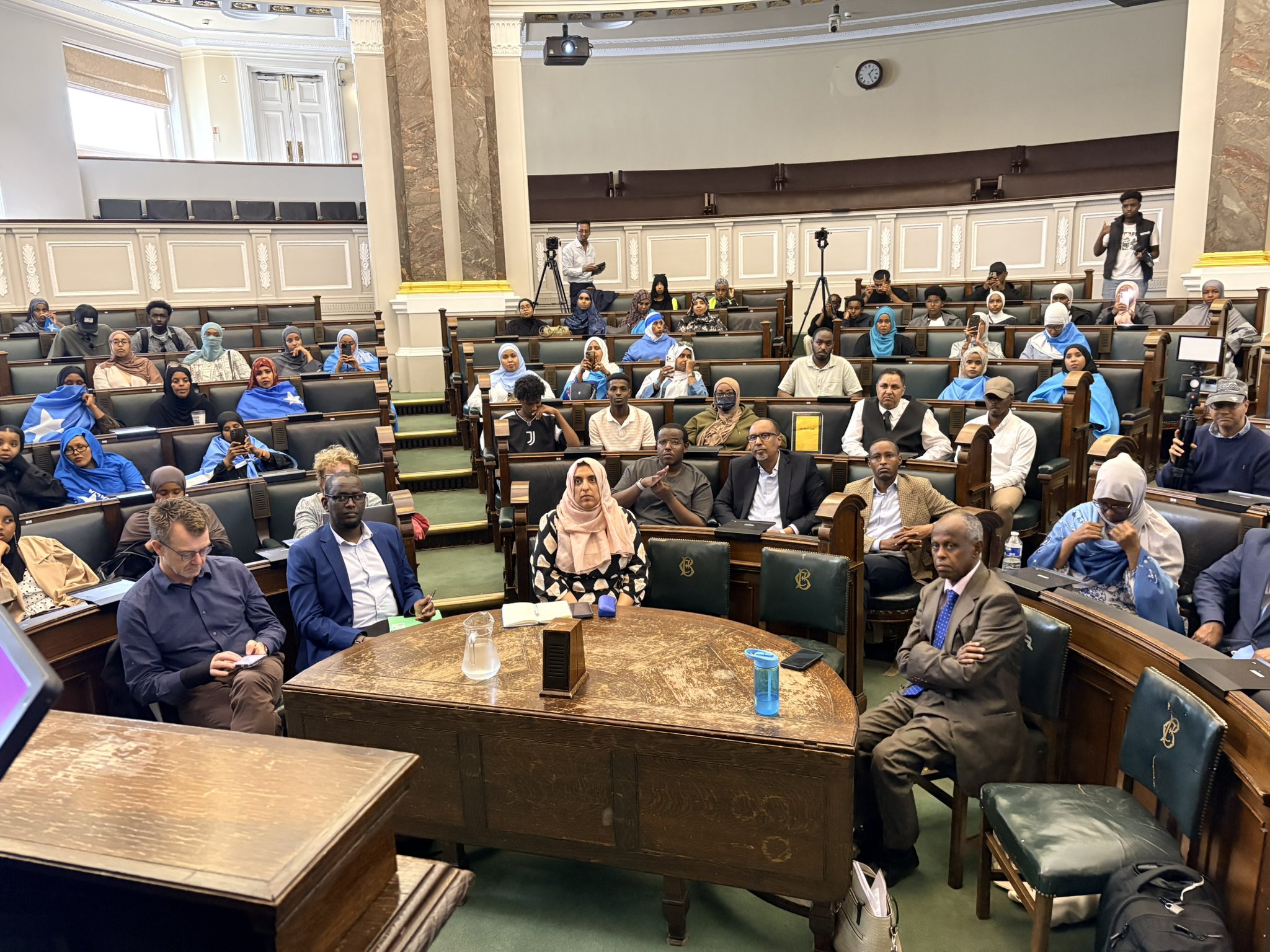
A Civic Roundtable followed at Birmingham City Council Chamber, bringing together civic leaders, academics, business leaders, civil society organisations, and members of the British Somali community to discuss the diaspora's growing contribution to civic leadership, education, entrepreneurship, and public service, and to reaffirm the shared commitment to building stronger and more inclusive communities.
The Lord-Lieutenant of the West Midlands represents the British Crown in the region. His presence at the Somali flag raising was not incidental. It was a signal, from the institution that represents the monarchy at the regional level, that the Somali community's place in Birmingham's civic life is recognised and valued.
What the Four Gestures Add Up To
Taken individually, each of these four things is significant. A royal letter. A beach video from the Ambassador. A landmark illumination. A historic flag raising with the Crown's regional representative present. Taken together, they are a picture of a bilateral relationship that has depth, texture, and genuine warmth running through its institutions at every level.
The British Somali community is one of the largest and most established Somali diaspora communities in the world. Birmingham alone has tens of thousands of Somali residents who have built lives, raised families, started businesses, and entered public service in the city over three decades. The events of 1 July 2026 reflected that history back at them in the most public way possible.
On Somalia's 66th Independence Day, the United Kingdom did not just send a message. A king wrote a letter. An ambassador stood on a beach. A library turned blue. And for the first time, the Somali flag went up at Birmingham City Hall. That is not protocol. That is a relationship.