Local News
More than 150 Somalis awarded Chinese government scholarships in record intake
Ambassador Wang Yu told a reception at the Amara Hotel that the civilian and military programmes had both reached record levels for a second year, in a cohort that has grown from sixteen students when the programme resumed to more than one hundred and fifty today.
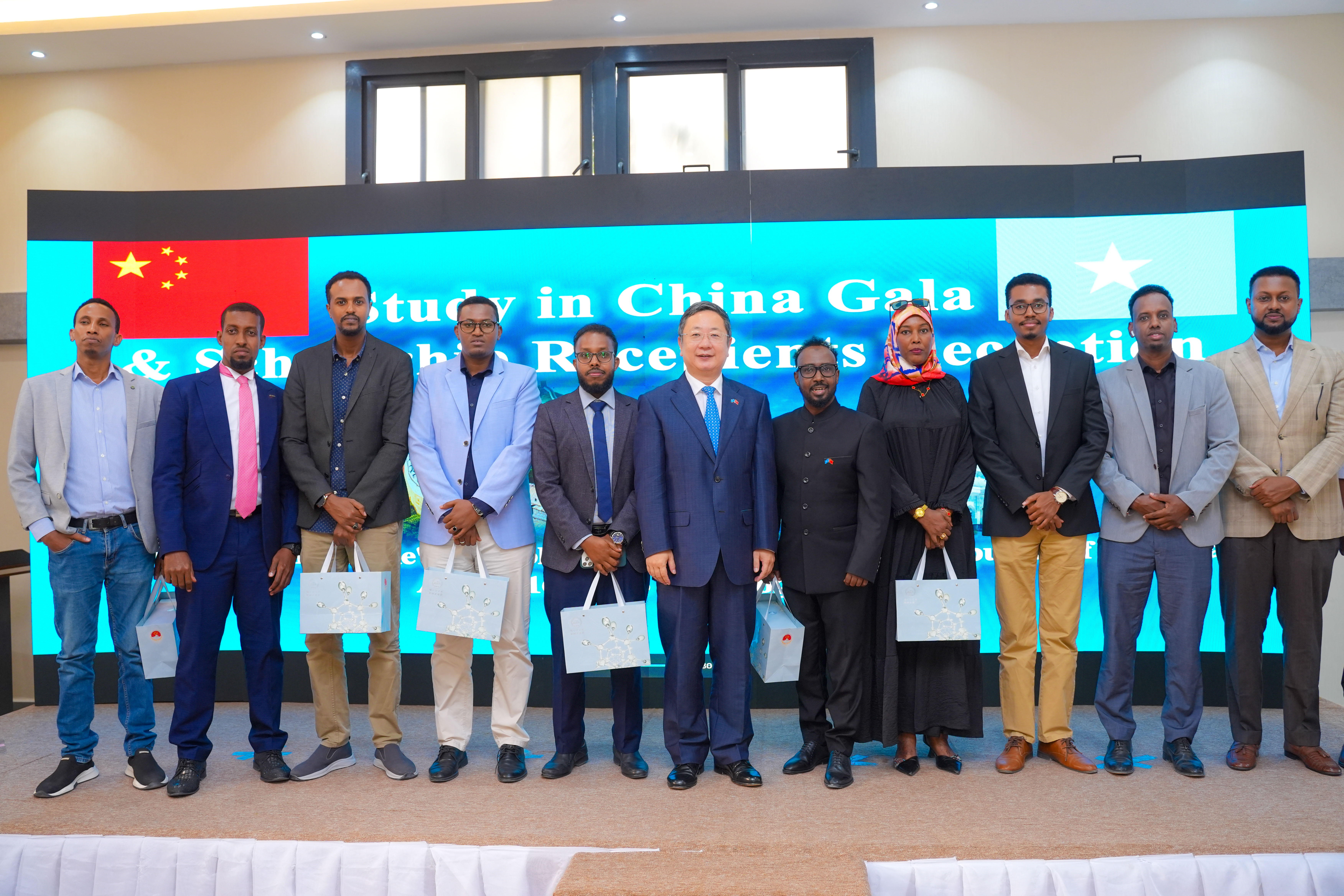
MOGADISHU (SONNA): More than 150 Somalis have been awarded Chinese government scholarships this year, the largest intake on record, in a cohort spanning government officials, military officers, law enforcement personnel and university students, the Chinese Ambassador to Somalia announced in Mogadishu on Sunday.
Speaking at the Study in China Gala and Scholarship Recipients Reception at the Amara Hotel, Ambassador Wang Yu said the number of recipients under the Ministry of Commerce scholarship scheme and the number admitted to military training programmes had both reached record levels for the second consecutive year. He said it was the second year running that the Embassy had held a joint reception for civilian and military recipients, a format that reflects how broadly the two governments now define educational cooperation.
Somalia was among the first African countries to recognise the People’s Republic of China, in 1960, and the Ambassador framed the awards within a bilateral relationship that has run for sixty six years since. He said the two countries had remained committed to mutual respect, equality and common development, and that practical cooperation had expanded across several sectors over the past two years. He cited a protocol signed last month setting inspection and quarantine requirements for Somali wild aquatic products entering the Chinese market under a zero tariff arrangement, and said further Somali products would follow so that the treatment delivers tangible benefits.
On development and humanitarian support, Wang Yu listed Chinese backing for the Somali diaspora centre, the National Leaders Academy and the new office building of the House of the People. He said China had provided three million United States dollars in humanitarian cash assistance since the end of last year, along with emergency food aid worth fifteen million Chinese yuan to support the response to severe drought, with a further consignment worth ten million yuan now under way.
The Ambassador told the recipients that most of them were travelling to China for the first time, and encouraged them to integrate into campus life, master their disciplines and return prepared to contribute to Somalia’s reconstruction and development. He said seeing is believing, and urged them to form their own view of the country and to build friendships that would strengthen ties between the youth of the two nations.
Mohamed Osman Omar, Member of the Federal Parliament and Minister at the Ministry of Family Affairs and Human Rights Development, gave the figure that framed the afternoon. He said the first cohort awarded scholarships after the programme resumed numbered sixteen students, against more than one hundred and fifty this year, and he named several of the early beneficiaries. He urged the departing students to remain humble, to absorb everything they could, and to understand that they now travel as representatives of their country carrying the weight of the Somali flag.
Abdirahman Mohamed Sheikh, Member of the Federal Parliament and Presidential Envoy for Health and Nutrition, thanked the Ambassador and spoke as a former student in China himself, recalling his own years there before urging the recipients to use the opportunity to improve their own lives and the condition of their country.
Yusuf Ali Mohamed, Permanent Secretary of the Ministry of Defence, and Abdirashid Abdisam Ali, Deputy Director of Higher Education at the Ministry of Education, Culture and Higher Education, also addressed the reception. Both thanked China for its support, with particular reference to the scholarships and to the training provided to Somali forces. Directors from the Ministry of Education, the Ministry of Public Works and the Ministry of Information attended, alongside members of the Somali Chinese alumni community and the Somalia China Friendship Association.
The programme opened with video testimony from Somalis already studying in China, at both undergraduate and postgraduate level. Hassan Abdulkadir Hashi, a student at Beihang University in Beijing, appeared with two certificates. One recorded a third prize in the university’s 2025 outstanding international student scholarship for academic excellence, alongside a full scholarship beginning in September. The other recorded a second prize in the Beijing regional round of the 2025 China International College Students Innovation Competition, for a non coplanar heterogeneous multirotor unmanned aerial vehicle project on which he is listed as project leader of a team otherwise composed of Chinese students. He urged incoming Somali students not to waste the opportunity and to do everything they could to make Somalia proud.
Another student described winning an excellence award at the seventh national undergraduate graduation design exchange for aerospace disciplines, for work on multi fidelity optimisation design for an electric vertical take off and landing configuration, and said his greatest achievement had been becoming the first international student at his university to win a national Chinese award. Further clips showed a Somali doctor working in a Chinese hospital and operating theatre, and a student at a school of civil engineering and architecture.
A second video block covered the military track. Somali officers were shown graduating from the International College of Defence Studies at the National Defence University in Beijing, receiving diplomas against a wall of national flags, and undertaking field training in Chinese uniform. One sequence showed a senior Chinese officer presenting a certificate to a Somali officer in dress uniform.
The most detailed account of the afternoon came from Sowdo Abdulkadir Ali Hure, speaking for the recipients of Chinese Government Scholarships. She began a Chinese language preparatory course at Tongji University in Shanghai in 2020 but studied online from Somalia because of the coronavirus pandemic. She formally enrolled in clinical medicine at Tongji Medical College of Huazhong University of Science and Technology in 2021 and still could not travel.
For two and a half years, until October 2022, she studied entirely online across a five hour time difference. Her live lectures began at three in the morning Somali time. She woke in the middle of the night, attended class and took notes, working around unreliable internet, telling herself the arrangement was temporary and the goal was worth it, with her family as her main source of encouragement.
She travelled to China for the first time in November 2022, and described arriving on campus after those years online as an emotional moment in which she finally met her teachers and classmates in person. She completed clinical training in hospitals, laboratories and classrooms, and noted that medical Chinese differs sharply from everyday Chinese. This September she returns to the same university for a master’s degree in ophthalmology, pursuing her aim of becoming an eye specialist.
The reception closed with awards to outstanding participants in the My Stories with China essay competition and a group photograph.
The distance between sixteen students and more than one hundred and fifty is the measure of what has been built in the years between, and the figures on their own describe only the outward part of it. What the afternoon set out more plainly was the shape of what returns. A student who led a Chinese engineering team on an aerial vehicle project, officers trained at a national defence university, a doctor working in a Chinese operating theatre, and a woman who sat through lectures at three in the morning for two and a half years and now goes back for a master’s in ophthalmology are not a cohort leaving the country. They are a cohort coming home, and the institutions waiting for them are the ones Somalia is still building.