
Local News
Cabinet takes up passport reform, trade law and judicial appointments
Ministers were told that amendments to passport data have been stopped entirely, approved a Rules of Origin Bill opening regional markets to Somali goods, and confirmed the appointed membership of the Judicial Service Council.
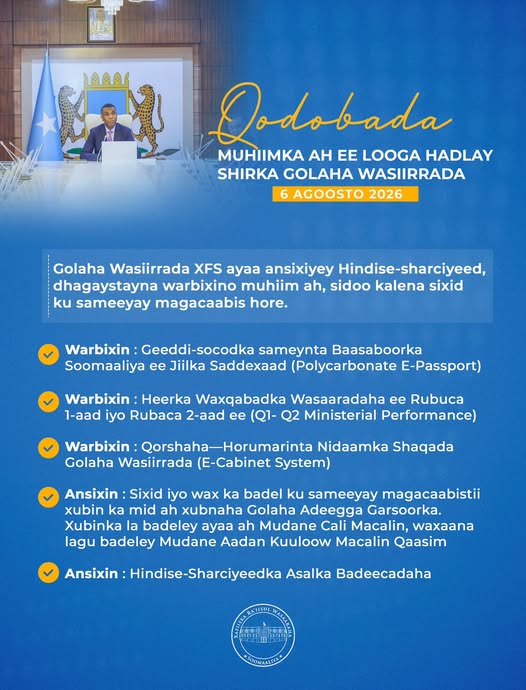
MOGADISHU (SONNA): The Council of Ministers has held its weekly meeting in Mogadishu under the chairmanship of Prime Minister Hamza Abdi Barre, taking up the general situation in the country, security and economic development, and receiving a report on the introduction of Somalia’s third generation polycarbonate electronic passport.
The report, presented by the Ministry of Internal Security with the design of the document and the production figures behind it, described the new passport as easing travel, reforming the document itself and changing the process by which citizens obtain one. The Ministry told the meeting that amendments to the personal data held in passports have been stopped entirely, a measure it said is intended to protect the standing of the document.
That measure addresses the difficulty at the centre of the matter. A travel document is only as useful as the willingness of other states to accept it, and the ability to alter personal details in an issued passport is the feature most likely to make a foreign immigration service treat a document with caution. Closing it off is a precondition for the acceptance the new passport is intended to secure.
Speaking to the meeting, the Prime Minister urged ministers and senior government officials to travel on Somali passports, saying this protects the standing and dignity that attaches to public office. He commended the Second Deputy Prime Minister, Jibril Abdirashid Haji, for returning his foreign passport.
The Council approved by majority vote a Rules of Origin Bill submitted by the Ministry of Commerce and Industry. Commerce and Industry Minister Jamal Mohamed Hassan said the law will allow goods with thirty percent or more Somali content to claim exemption from duty in the markets they are sent to, and introduces a certificate showing that a product came from Somalia together with documentation establishing its origin.
He said the measure follows Somalia’s entry into the East African Community and the ratification by parliament of the African Continental Free Trade Area agreement, which the President recently signed, and that it is intended to encourage production inside the country, the establishment of factories and the growth of exports. Rules of origin determine which goods qualify for preferential treatment under a trade agreement, and without them a member of a free trade area has no means of using the access it has joined for.
The two measures approach one difficulty from different directions. A passport certifies who is Somali and a certificate of origin certifies what is Somali, and in each case the value of the document rests on whether the institutions receiving it treat it as reliable.
The Council also confirmed the appointed membership of the Judicial Service Council, the body established under Article 145 of the Provisional Constitution, amending one name from an earlier decision on a proposal from the Ministry of Justice and Constitutional Affairs. Abdiqadir Ali Ma'alin was replaced by the legal specialist Adan Kuulow Ma'allin Qasim, joining Mohamed-deeq Ma'allin Adan, Maryan Sheikh Osman and Abdirisak Mohamed Ismail. The four are senior advocates, legal specialists and academics, and will serve terms of five years.
The remaining seats on the Council are held by virtue of office, among them the Chief Justice of the Supreme Court, the Chairman of the Constitutional Court, the Attorney General, the chief justices of the high courts of the federal member states and the Banadir administration, and the Chairperson of the National Independent Human Rights Commission. The Council carries the constitutional responsibility for the appointment, discipline and administration of the judiciary, which makes the completion of its membership a step in the wider reconstruction of the justice sector.
Ministers received performance reports for the first and second quarters from across government, and considered a plan for the development of an electronic cabinet system, both presented by senior officials of the Office of the Prime Minister together with specialists.
The Prime Minister briefed the Council on his recent visit to the North Eastern State, commending what he described as the cohesion between the administration there and the people, and congratulated Galmudug on the one person one vote election held in the state.
Taken together the agenda was largely a matter of institutional machinery. A passport other governments will accept, a certificate that allows Somali goods through a customs post at a preferential rate, a body with the standing to appoint and discipline judges, and a system for measuring what ministries have done are not the announcements that draw attention, but they are the arrangements by which a state either functions or does not.