Local News
Abdulkadir Mohamed Nur elected Speaker, and resigns from government and party the same day
The Minister of Ports and Marine Transport took 142 votes to 30 in the House of the People, then told members he had left every post he held in the executive and in the Justice and Solidarity Party to preserve the impartiality of the chair.
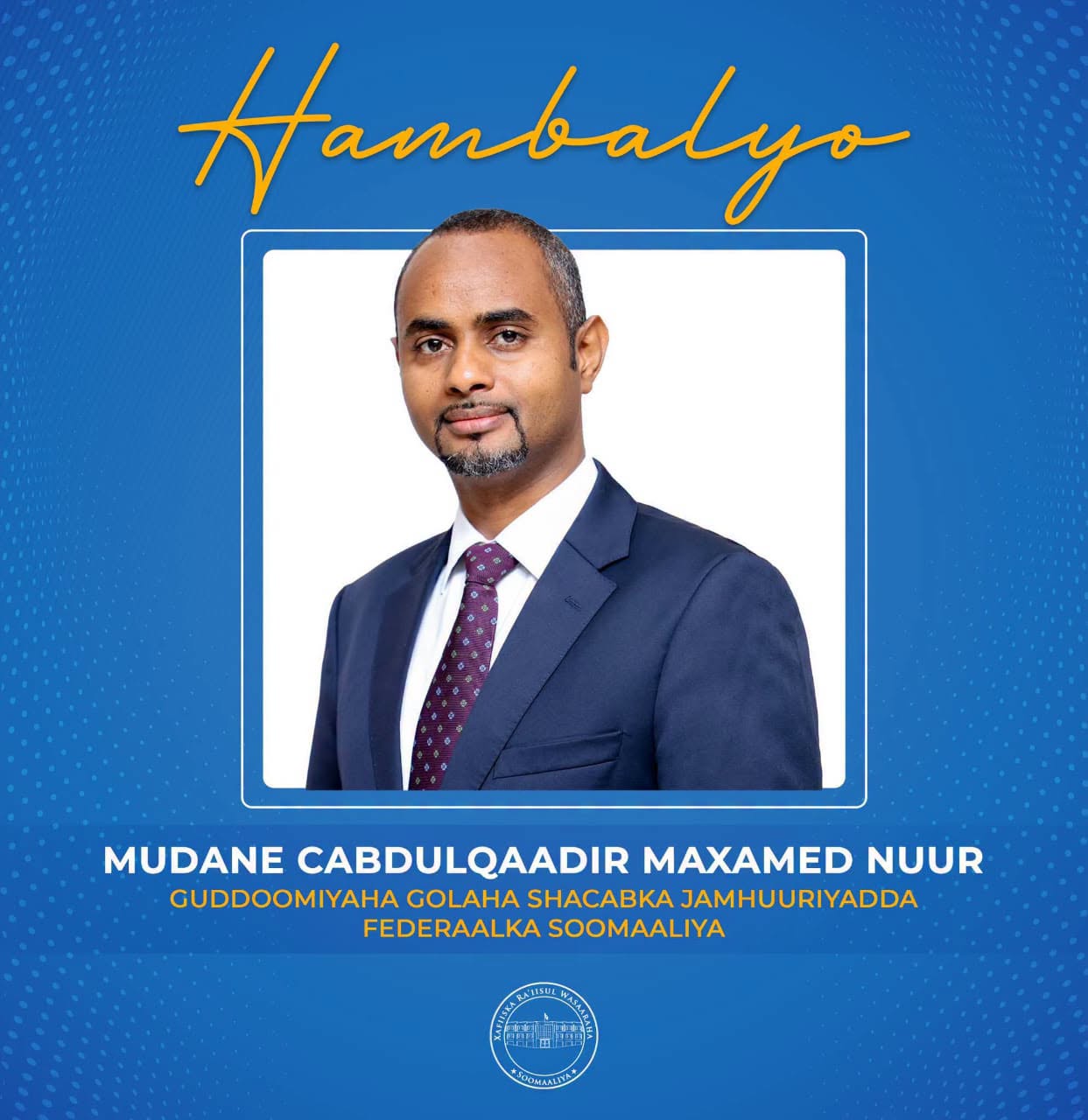
MOGADISHU (SONNA): Abdulkadir Mohamed Nur has been elected Speaker of the House of the People of the Federal Parliament, taking 142 votes against 30 for the other candidate, Abdulkadir Omar Maalin, with two ballots declared spoiled.
The ballot was held under the supervision of the Acting Speaker, Sacdiya Yasin Haji Samatar, with the organisation and administration handled by the nine member election committee she appointed on 2 August, chaired by Abdirisaq Omar Mohamed. The vote fills a post that has been vacant since June, when Adan Mohamed Nur (Madobe) left the speakership after his election as State Leader of South West.
In his address to members after the result, the new Speaker said he had resigned every position he held in the government and in the Justice and Solidarity Party, citing Article 86(2) of the Constitution and Article 13(9) of the internal rules of the House, which govern elections to the presidency of the chamber. He said the purpose was to protect the impartiality of the office and the constitutional duty attaching to it.
That announcement carries a practical consequence. The Speaker held the portfolio of Ports and Marine Transport until his election, which means the ministry is now without a minister at a point when it is central to the fisheries project agreed between Somalia and Türkiye, and only days after a new director general was appointed to it.
He thanked every member who had voted freely, those who had supported him and those who had not, and thanked in particular the members who came to the chamber to vote while unwell, some of them in wheelchairs, saying he would work on the welfare of members. He also thanked the presidency of the chamber and the election committee for the manner in which they conducted the ballot.
The most substantial commitment in the speech concerned members who have stayed away from the House. The Speaker said there are colleagues absent in political councils who hold political grievances, and that he would develop a clear policy for resolving those grievances and bringing them back, working with his deputies, the parliamentary committees, the President and the executive. He said he would also work with the parliaments of the federal member states and move to accelerate cooperation between them and the federal legislature.
The undertaking is a considerable one. A speaker who resigns his party membership on the day of his election and then offers to negotiate the return of absent members is describing a particular understanding of the office, in which the chair is a point of mediation between the parts of the political system rather than an extension of the largest bloc within it. Whether it can be delivered is a separate question, and it depends on parties the Speaker does not control.
The Speaker brings an unusually wide official record to the chair. He graduated in 2015 from the Faculty of Political Sciences at Ankara University, and served at the Somali embassy in Ankara from 2009 to 2016, first as second secretary and later as first secretary. He was subsequently deputy head and acting head of the National Intelligence and Security Agency, then Minister of Justice from October 2020 to December 2021, and later held the defence portfolio before moving to ports and marine transport.
His platform to members set out five areas of work: stronger oversight of the executive, faster handling of important legislation, improved professional and technical capacity within parliament, wider cooperation with foreign legislatures, and better conditions for members. He also undertook to strengthen the parliamentary committees, improve research and legal advisory services, make greater use of technology, and establish regular training for members and parliamentary staff.
Closing his address, he asked members to expect what he called a new Jaamac, one who is in no personal political contest with anyone and who acts as an advocate for every Somali, while remaining the same person to those who have travelled with him. He said the outcome of the day was a victory for justice and equality, for peace and coexistence, for the unity of the country and the defence of its sovereignty, and for the young Somalis he said he particularly represents.
The office he takes carries weight beyond the chamber. The Federal Parliament is in the eighth of the ten sessions the President identified last week as the window for completing the constitutional and legislative work before it, including the alignment of existing law with the constitution and the ratification of international agreements. The Speaker will preside over that work, and he will do so having given up, on his first day, the party affiliation through which such work is ordinarily coordinated.